Batavia: The human side of the story with Stefanie Koens and Sharyn McCaskey

Advertisement
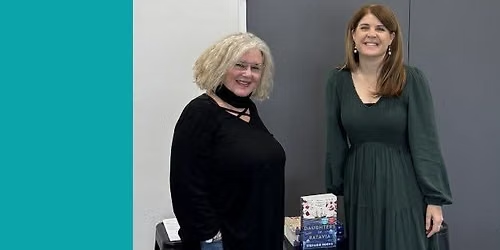
Sharyn McCaskey Storyteller along with Stefanie Koens Author of Daughters of Batavia will share with you the Batavia Shipwreck its survival, courage, and some of the human stories behind the infamous Batavia shipwreck.
This will be more of a discussion than a speech.
We will delve into the more personal aspect to the story.
This is not a book talk, but a discussion on the people from someone who has researched the human aspect of the story.
21st July - Tuesday
6.15pm for a 6.30pm Arrive and mingle.
6.30pm Maawa Update
6.35pm Our Speaker then Q & A
7.15pm Stay and mingle with members
At the Rottnest Island Authority Walyalup Office,
1 Mews Rd, Fremantle.
Free parking is available at Reception and along Mews Rd.
Google has this as a toilet block; we are just behind it.
Come one COME ALL - Bring a friend, ask your neigbour, see if your mum is available!
Stefanie will sign her book, if you have a copy bring it, however if you wish to purchase one, she’ll have a limited supply for sale, Cash Pls $35.00 - this is a FREE talk with NO obligation to buy a book!
_______________________________________________________________
UPDATE YOURSELF HERE WITH DETAILS
The Batavia story is one of history's most infamous and gruesome sagas of shipwreck, mutiny, and mass murder. It took place on a remote, barren cluster of islands off the coast of Western Australia in 1629.
The Voyage and The Wreck
• The Ship: The Batavia was a magnificent flagship belonging to the Dutch East India Company (VOC). She embarked on her maiden voyage in 1628, carrying hundreds of passengers, soldiers, and a vast fortune in silver and trade goods.
• The Mutiny Plot: During the long voyage, a ruthless under merchant named Jeronimus Cornelisz and the ship's skipper, Ariaen Jacobsz, conspired to seize the ship, murder its leaders, and use the treasure to become pirates.
• The Sinking: On the moonlit night of June 4, 1629, the Batavia struck Morning Reef in the Houtman Abrolhos Islands (about 65 kilometres off the coast of Western Australia). Around 250 people survived the wreck and managed to scramble onto nearby waterless islands.
The Reign of Terror
• The Commander Leaves: With limited water and supplies, the ship's commander, Francisco Pelsaert, along with the mutinous skipper Jacobsz, took a longboat and sailed all the way to Batavia (modern-day Jakarta, Indonesia) to get help. The perilous 3,000 km journey took them 33 days.
• The Bloody Purge: Back on the islands, Cornelisz took full control. Realizing that his food and water would not last until a rescue ship arrived, he established a tyrannical reign of terror. To eliminate mouths to feed and prevent anyone from rising up, Cornelisz and his loyal mutineers began brutally murdering over 125 men, women, and children.
• The Resistance: Cornelisz had tricked a group of unarmed soldiers—led by a brave mercenary named Wiebbe Hayes—into traveling to a neighboring island, expecting them to die of thirst. Miraculously, Hayes’ men found fresh water. When they learned of the massacre from an escaped victim, they armed themselves with limestone weapons and makeshift pikes, building the oldest-known European structures in Australia for defense. They successfully repelled several attacks by the mutineers.
Rescue and Retribution
• The Rescue: After an incredible 33-day voyage and an arduous return trip, Commander Pelsaert arrived in the rescue ship Sardam. Hayes' loyal soldiers managed to intercept the rescue ship just moments before the mutineers could, revealing the horrifying truth.
• Justice: Pelsaert's armed crew quickly overpowered the mutineers without a fight. Following a swift trial and torture to extract confessions, Cornelisz and the main conspirators were hanged on makeshift gibbets on the islands.
• The First European Settlers: Two of the youngest mutineers who were considered less guilty were spared from the gallows. Instead, they were marooned on the Western Australian mainland. They became the first recorded European residents in Australia, though they disappeared into history without a trace.
Maritime Archaeology:
Unlocking the Secrets
The discovery and excavation of the Batavia essentially birthed the field of maritime archaeology in Australia.
The Discovery (1963): The wreck was formally located on Morning Reef by a team of divers, prompting the state of Western Australia to pass strict laws to protect it from treasure hunters.
The Hull Excavation (1970s): Led by the Western Australian Museum, archaeologists undertook a massive underwater excavation to raise the fragile timbers. This required pioneering wood-preservation techniques, soaking the timber for years in chemical baths to pull out destructive sea salts before they could rot in the open air.
Forensic Archaeology: Expeditions back to Beacon Island continue to uncover history. Forensic scientists and archaeologists regular discover new mass graves. Using modern isotopic testing and DNA sequencing on teeth and bone fragments, they have been able to determine the diet, origin, and even approximate identities of the specific VOC passengers who fell victim to the mutiny
This will be more of a discussion than a speech.
We will delve into the more personal aspect to the story.
This is not a book talk, but a discussion on the people from someone who has researched the human aspect of the story.
21st July - Tuesday
6.15pm for a 6.30pm Arrive and mingle.
6.30pm Maawa Update
6.35pm Our Speaker then Q & A
7.15pm Stay and mingle with members
At the Rottnest Island Authority Walyalup Office,
1 Mews Rd, Fremantle.
Free parking is available at Reception and along Mews Rd.
Google has this as a toilet block; we are just behind it.
Come one COME ALL - Bring a friend, ask your neigbour, see if your mum is available!
Stefanie will sign her book, if you have a copy bring it, however if you wish to purchase one, she’ll have a limited supply for sale, Cash Pls $35.00 - this is a FREE talk with NO obligation to buy a book!
_______________________________________________________________
UPDATE YOURSELF HERE WITH DETAILS
The Batavia story is one of history's most infamous and gruesome sagas of shipwreck, mutiny, and mass murder. It took place on a remote, barren cluster of islands off the coast of Western Australia in 1629.
The Voyage and The Wreck
• The Ship: The Batavia was a magnificent flagship belonging to the Dutch East India Company (VOC). She embarked on her maiden voyage in 1628, carrying hundreds of passengers, soldiers, and a vast fortune in silver and trade goods.
• The Mutiny Plot: During the long voyage, a ruthless under merchant named Jeronimus Cornelisz and the ship's skipper, Ariaen Jacobsz, conspired to seize the ship, murder its leaders, and use the treasure to become pirates.
• The Sinking: On the moonlit night of June 4, 1629, the Batavia struck Morning Reef in the Houtman Abrolhos Islands (about 65 kilometres off the coast of Western Australia). Around 250 people survived the wreck and managed to scramble onto nearby waterless islands.
The Reign of Terror
• The Commander Leaves: With limited water and supplies, the ship's commander, Francisco Pelsaert, along with the mutinous skipper Jacobsz, took a longboat and sailed all the way to Batavia (modern-day Jakarta, Indonesia) to get help. The perilous 3,000 km journey took them 33 days.
• The Bloody Purge: Back on the islands, Cornelisz took full control. Realizing that his food and water would not last until a rescue ship arrived, he established a tyrannical reign of terror. To eliminate mouths to feed and prevent anyone from rising up, Cornelisz and his loyal mutineers began brutally murdering over 125 men, women, and children.
• The Resistance: Cornelisz had tricked a group of unarmed soldiers—led by a brave mercenary named Wiebbe Hayes—into traveling to a neighboring island, expecting them to die of thirst. Miraculously, Hayes’ men found fresh water. When they learned of the massacre from an escaped victim, they armed themselves with limestone weapons and makeshift pikes, building the oldest-known European structures in Australia for defense. They successfully repelled several attacks by the mutineers.
Rescue and Retribution
• The Rescue: After an incredible 33-day voyage and an arduous return trip, Commander Pelsaert arrived in the rescue ship Sardam. Hayes' loyal soldiers managed to intercept the rescue ship just moments before the mutineers could, revealing the horrifying truth.
• Justice: Pelsaert's armed crew quickly overpowered the mutineers without a fight. Following a swift trial and torture to extract confessions, Cornelisz and the main conspirators were hanged on makeshift gibbets on the islands.
• The First European Settlers: Two of the youngest mutineers who were considered less guilty were spared from the gallows. Instead, they were marooned on the Western Australian mainland. They became the first recorded European residents in Australia, though they disappeared into history without a trace.
Maritime Archaeology:
Unlocking the Secrets
The discovery and excavation of the Batavia essentially birthed the field of maritime archaeology in Australia.
The Discovery (1963): The wreck was formally located on Morning Reef by a team of divers, prompting the state of Western Australia to pass strict laws to protect it from treasure hunters.
The Hull Excavation (1970s): Led by the Western Australian Museum, archaeologists undertook a massive underwater excavation to raise the fragile timbers. This required pioneering wood-preservation techniques, soaking the timber for years in chemical baths to pull out destructive sea salts before they could rot in the open air.
Forensic Archaeology: Expeditions back to Beacon Island continue to uncover history. Forensic scientists and archaeologists regular discover new mass graves. Using modern isotopic testing and DNA sequencing on teeth and bone fragments, they have been able to determine the diet, origin, and even approximate identities of the specific VOC passengers who fell victim to the mutiny
Advertisement
Where is it happening?
1 Mews Road , Fremantle, WA, Australia, Western Australia 6160
Event Location & Nearby Stays:
Know what’s Happening Next — before everyone else does.
Host or PublisherMaritime Archaeological Association of Western Australia - MAAWA