Animal Trainers' Retreat: Training With Love + Science

About this Event
A retreat in a sublime location, this event offers a relaxed mini conference-type learning opportunity and hands-on training experience. Regardless of where you are in your journey to be the best trainer you can be, this weekend has something to help you positively affect the lives of people and their animals. We have brought together a stellar lineup of some of the best trainers and presenters in the business to give talks and lead discussions on their latest research and behavior analytic-based training procedures. Kicking off the weekend is a panel discussion related to applied behavior analysis providing an overarching framework for training and welfare, and why some well-established practitioners pursue advanced study in the discipline. Following the panel discussion, informational presentations will be interspersed with applied learning interactions using the Portable Operant Research and TeachingLab (PORTL) and working with the animals of Lemon's Hope Sanctuary.
Our panel discussion will include Rick Hester, Director of Animal Care and Wellbeing at the Cheyenne Mountain Zoo in Colorado and Behavior Consultant with Behavior Works; Kiki Yablon, MA, KPA CTP, CPDT-KA, KPA and Behavior Works Faculty, of Kiki Yablon Dog Training ; Laura Monaco Torelli, KPA CTP/ Faculty, CPDT-KA, TAGteach Level 2 of Animal Behavior Training Concepts; Mindy Waite, Ph.D., MS, CAAB, CPDT-KA, Clinical Assistant Professor in Animal Behavior at Carroll University; Morgan Katz, MS, KPA CTP, Director of Behavior Services at MSPCA-Angell; Debbie Jacobs, CPDT-KA, RBT, award-winning author and creator of the Fearful Dogs website and Facebook group of the same name; Maia Nahele Owen, Ph.D., MA, KPA-CTP, of Behavior Explorer and the Victoria Stillwell Academy; Keira Moore, Ph.D., KPA-CTP, of Pet Project Dog Training; Annie Grossman, KPA-CTP and author of How to Train Your Dog With Love + Science; and Dianne Keck, KPA-CTP, SDC, of NeuroDog Training LLC.
PORTL is an interactive tabletop game for learning about behavioral principles and phenomena, honing training mechanics, improving teaching skills, and conducting research. It is played using a collection of small objects, a clicker to select behavior, and small blocks as reinforcers. In addition to providing an experiential learning opportunity, PORTL is a lot of fun to play.
Animals at Lemon's Hope include horses, guinea pigs, sheep, a goat, rats and resident dogs. Teaching even simple behaviors to different species and individuals than those one typically works with builds a trainer's fluency in adapting and generalizing mechanics, reinforcement principles and teaching strategies, and deepens understanding. Your feed delivery, rate and criteria changes will vary by necessity.
The event will be hybrid in format, with both in person attendance and presentations, and remote attendance and presentations. Online attendance is for the talks only, which will occur throughout the weekend with breaks. Topics and schedule, which is subject to change, are listed in the Agenda.
Speakers will include:
Rick Hester, Director of Animal Care and Wellbeing, Cheyenne Mountain Zoo
Kiki Yablon, MA, KPA-CTP, CPDT-KA, KPA Faculty
Mindy Waite, Ph.D., MS, CAAB, CPDT-KA
Maia Nahele Owen, Ph.D., MA, KPA-CTP
Morgan Katz, MS, KPA CTP
Catja B Pedersen
Ceus:
CCPDT: 6 for trainers and 12 for behavior consultants for in person attendees; 6 for online only
KPA: 10 for in person and 7 for online only
PPAB: 9 for in person attendance and 7 for online only
IAABC: 13 for in person attendance and 7 for online only
Schedule subject to change
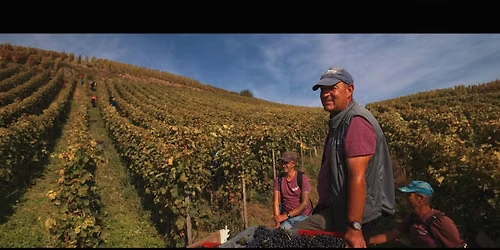
The animals here are rescued or rehomed from various situations. They are our best teachers. And such fun to work with, as shown in the video testimonial from one of our past attendees.
Another part of the applied experience at our retreats is playing the tabletop training game PORTL. This year, Hannah McGee, MS, CBCC-KA, Behavior Manager at MSPCA-Angell, will guide us through PORTL play so that the animal time and PORTL activities mirror each other.
Agenda
🕑: 09:00 AM - 09:15 AM
DAY ONE: Check in
🕑: 09:15 AM - 09:30 AM
Intros
🕑: 09:30 AM - 10:30 AM
Panel discussion: ABA as an overarching, holistic training framework
Info: Those who immerse themselves in applied behavior analytic-based teaching and training experience it as an overarching framework that accounts for a holistic practice, that may take into consideration all aspects of behavior when designing training plans for an individual and their caretakers. We will examine how ABA provides this framework, what is radical about radical behaviorism and why that matters. We will also ask the question, why are accomplished trainers with successful practices and solid backgrounds getting advanced education in ABA? What are exciting recent developments in applied animal behavior analysis that may expand the application of behavior analytic principles to produce better outcomes with our learners? Panel participants will include Rick Hester, Kiki Yablon, Mindy Waite, Maia Nahele-Owen, Morgan Katz, Laura Monaco Torelli, KPA CTP/ Faculty, Debbie Jacobs, CPDT-KA, RBT, and Annie Grossman, CPDT-KA, KPA CTP.
🕑: 10:45 AM - 11:45 AM
A Free Operant Approach to Behavioral Enrichment
Info: This talk by Rick Hester, who has been working with Dr. Susan Friedman of Behavior Works on designing environments for animals that are rich in behavioral opportunities, will discuss in depth how to create meaningful environments for animals in our care. In many captive environments, animals are waiting to do things. They are waiting for people to provide them with activities. By focusing on behavior management with a free operant approach--setting up the environment so that animals may engage in a rich variety of natural activities at any point in their day without human intervention--they have the freedom to engage in a variety of behaviors, at the speed and frequency and with the repetition that they determine on their own. The animals are free to operate on their environment to gain outcomes. They are no longer waiting for people to provide activity. They can do it themselves, improving welfare through behavior.
🕑: 12:00 PM - 01:00 PM
PORTL play!
Info: PORTL stands for the Portable Operant Research and Teaching Lab, a tabletop game that explores training mechanics and scientific principles of reinforcement. Our PORTL sessions will be designed so that they mirror the training that will occur with the sanctuary animals. The two applied experiences will make for stronger learning and practice.
🕑: 01:00 PM - 02:30 PM
Lunch
🕑: 02:30 PM - 03:30 PM
Developing a Crate Training Protocol and Testing Calming Caps in Dogs
Info: Dr. Mindy Waite will discuss what worked, what didn't, and lessons learned in recent research at her university on crate training and the use of calming caps. Her lab developed and tested a crate training protocol based on the ping pong pattern game originally developed by Leslie McDevitt. The protocol included both positive reinforcement (food) and negative reinforcement (escape) for desired behaviors. To address dog-dog reactivity toward unfamiliar dogs, the lab tested the use of Calming Caps, which have been recommended for decades as a tool to address reactivity by reducing the dog’s ability to intake visual stimuli. In addition to reviewing study methods and outcomes, this talk will focus on practical implications for trainers and caretakers, including how reinforcement-based crate training protocols can be implemented effectively, when visual attenuation tools may or may not be appropriate, and how unsuccessful or mixed findings can still inform better training decisions.
🕑: 03:45 PM - 05:00 PM
Train some animals!
Info: Animal learner-trainer teams and behaviors to work on TBD. Among the behaviors attendees may work on with the sanctuary animals are stationing, targeting, coming when called, walking with people, trailering, touch acceptance, etc. Our animals include horses, sheep, a disabled goat, guinea pigs, rats and dogs.
🕑: 09:00 AM - 09:15 AM
DAY TWO: Check in
🕑: 09:15 AM - 10:15 AM
Thinking Outside the Treat Pouch: Naturally Occurring Reinforcers
Info: Kiki Yablon will explore teaching with and transitioning to naturally occurring reinforcers. Food is often the first reinforcer we use in positive reinforcement training. It’s a primary reinforcer, it’s easy to deliver in discrete chunks, and most animals respond eagerly to it across situations. But there are also contexts in which we may wish not to rely on food, such as animals having dietary restrictions or when food becomes a cue for the dog to offer unwanted behaviors. We can teach behaviors with the reinforcers they’re meant to be used for—aka “naturally occurring”—but it’s not always easy or kind. We can also use food to build behavior that is robust enough for the learner to contact naturally occurring reinforcers, but there are some tricks to ensure a smooth transition. Kiki will discuss benefits and pitfalls of edible reinforcers, how reinforcers can also become cues, what constitutes a naturally occurring reinforcer, and how and when to teach with or transition to them.
🕑: 10:30 AM - 11:30 AM
PORTL play!
Info: Building on previous day's session.
🕑: 11:45 AM - 12:45 PM
A discrete study of separation anxiety
Info: This talk by Morgan Katz will examine her master's research into separation anxiety.
🕑: 12:45 PM - 01:30 PM
Lunch
🕑: 01:30 PM - 02:30 PM
Lasagna is your favorite food: behavior reduction and constructional teaching
Info: Maia Nahele Owen's talk will explore decreasing "problem" behavior and preserving desired behavior (i.e. preventing decrease) are both central concerns for most of us working in the real world. Trainers say often when they implement a procedure and a behavior decreases "technically it’s punishment.” That line reflects a common confusion—treating the quadrants as if they are the whole analysis of behavior. But many other processes might account for a decrease in response rates. Maya will examine seven hypothetical scenarios that all produce decreases in behavior using something the learner supposedly really wants (that's the lasagna in the title). Most are not punishment, only one plausibly is. The focus is on what would actually distinguish these cases in practice, and what evidence would help us identify the underlying process. The processes are not equivalent. Some produce more durable, flexible change than others—this is where a constructional approach becomes especially useful.
🕑: 02:45 AM - 03:45 AM
Train some animals!
Info: Continuation from previous day's sessions.
🕑: 04:00 PM - 05:00 PM
Using cooperative care principles in teaching children
Info: Presentation by Catja B. Pedersen. When working with animals, we know about criteria and setting up for success, but when we are working with tiny humans, we often expect them to adapt on their own. Having the benefit of speaking the same language, we forget that our spoken language is full of concepts and labels that are hard to grasp for a child who is still learning to navigate the world. What if we took our knowledge and applied it to teaching children as well? Using the skills we already have for teaching cooperative care and giving them the chance to opt in and out of situations influences how they treat others and how they handle new challenges. We’re going to investigate how we can apply the skills we have learned through animal training to the humans we’re working with. And how a little bit of work goes a long way into the future of those learners. The best way to teach children about consent is to allow them to exercise it.
Where is it happening?
Event Location & Nearby Stays:
USD 214.19 to USD 534.31