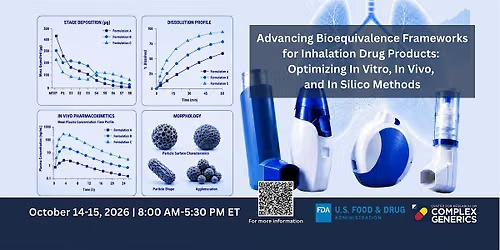
Advancing BE Frameworks for Inhalation Drug Products: Optimizing Methods

About this Event
Advances in analytical methods and bioequivalence assessment science have driven the evolution of bioequivalence recommendations for locally acting inhalation products toward option-based bioequivalence frameworks, incorporating innovative in vitro, in vivo, and in silico methods as viable alternatives to comparative clinical endpoint studies. These developments represent meaningful opportunities to modernize and strengthen the development and approval of generic inhalation products. As with any emerging methodology, their novelty may give rise to questions where additional clarity could further support their implementation. This workshop will explore these opportunities with the goal of building shared understanding, refining best practices, reducing redundancies, and streamlining evaluations that will ultimately support more efficient generic development programs and timely approvals.
Attendees will gain valuable insights into the current understanding, regulatory expectations, and industry experiences with developing, validating, and using in vitro and in vivo methods included as part of bioequivalence recommendations for metered dose inhalers (MDIs) and dry powder inhalers (DPIs) without significant formulation differences with their reference standard (RS). The final session of the workshop will explore the potential for using innovative in vitro and in vivo methods in these option-based frameworks with products containing significant formulation differences with their RS. In addition to a series of expert-led presentations and panel discussions, in-person attendees will interact directly with experts from industry, academia and regulatory agencies to better understand the current practices and considerations with conducting these studies.
The two-day workshop is designed to discuss in vitro methods for particle size distribution, dissolution and particle morphology; the current expectations and potential alternatives to charcoal block in vivo pharmacokinetic studies; a look forward at opportunities to expand use of these bioequivalence approaches and areas for products with significant formulation differences from their RS.
Agenda
D1 S1: Current Bioequivalence Approaches for Inhalation Drug Products
Info: Presentations (in person and virtual): This session details the Agency’s latest advancements in bioequivalence (BE) strategies recommended for inhalation products, their associated challenges, and opportunities for clarity and efficiency. Topics include the current option-based framework, recommended BE studies, method considerations, industry experiences and challenges, and future directions for research initiatives and additional guidance.
D1 S2: Revisiting Realistic Particle Size Distribution Study Designs/Analyses
Info: Presentations and Panel Discussion (in person and virtual): This session examines the FDA expectations and industry experience with conducting conventional and realistic APSD studies. Speakers will cover topics such as selection and use of anatomical mouth-throat models and breathing profiles, approaches for statistical analyses, study size, capturing clinically relevant variability, bracketing approaches, and potential opportunities for addressing common challenges.
D1 S3: Expectations for Designing Sensitive Dissolution Methods
Info: Presentations and Panel Discussion (in person and virtual): This session examines the FDA expectations and industry experience with dissolution studies. Speakers will cover topics on the rationale and utility of dissolution for inhalation products, method development and sample collection, validation, demonstrating sensitivity, approaches for statistical analysis, and applicability of biopredictive and/or biorelevant approaches.
D1 S4: Expectations and Opportunities with Particle Morphology Testing
Info: Presentations and Panel Discussion (in person and virtual): This session examines the FDA expectations and industry experience with particle morphology characterization studies. Speakers will cover topics on purpose of utility of particle morphology characterization across inhalation products, current and alternative methods for morphology characterization, and considerations and challenges with multi-component formulations.
D1 S5: Meet & Learn (in person only)
Info: Interactive Discussions on Focused Product Development and Assessment Areas (in person only): FDA reviewers from multiple FDA Offices involved with assessing different aspects of information submitted in ANDAs for generic orally inhaled drug products will interact in an informal setting with in-person attendees to discuss and clarify FDA’s review process, as well as scientific and regulatory considerations. Experts from Industry, Academia, and the FDA who are subject matter experts in their respective disciplines will share each other’s real-world challenges and discuss viable approaches to facilitate the successful development and assessment of generic orally inhaled drugs. Specific topics will include:
• In Vitro Bioequivalence Studies: From Eligibility to Analytical Methods
• In Vivo Bioequivalence Studies: Study Design, Population, & Modeling
• Drug Product Quality Assessment and Manufacturing Considerations
• Human Factors and Comparative Analyses: Showing Substitutability
D2 S6: Small Group Working Session (in person only)
Info: Interactive Working Session (in person only): In this collaborative session, participants will join small-group discussion tables facilitated by FDA, industry, and academic experts. In-person attendees will engage in guided discussions and exercises related to Sessions 2-4, building consensus, and reporting of actionable research or recommendations. The outcome of this session will be a meeting report summarizing key discussion points, consensus findings, and emerging recommendations, which will be shared publicly after the workshop.
D2 S7: Waivers for In Vitro & In Vivo PK Studies– Challenges & Opportunities
Info: Presentations and Panel Discussion (in person and virtual): This session explores the considerations and challenges with the recommended in vivo PK BE studies, including more complex designs like charcoal-block studies. Speakers will cover topics related to the rationales for current recommendations, implications and experiences from industry, and where alternative methods like in silico modeling may have potential for improving efficiency.
D2 S8: Moving Beyond Formulation Sameness
Info: Presentations and Panel Discussion (in person and virtual): The final hybrid session focuses on the implications of formulation sameness recommendations for inhalation products. Speakers will cover topics on the role of formulation sameness with inhalation products based on current scientific understanding, along with potential opportunities for moving beyond these recommendations through improved understanding of the critical factors governing product performance.
Where is it happening?
USD 0.00 to USD 350.00