5th International Conference on NLP and Machine Learning Trends (NLMLT 2026)
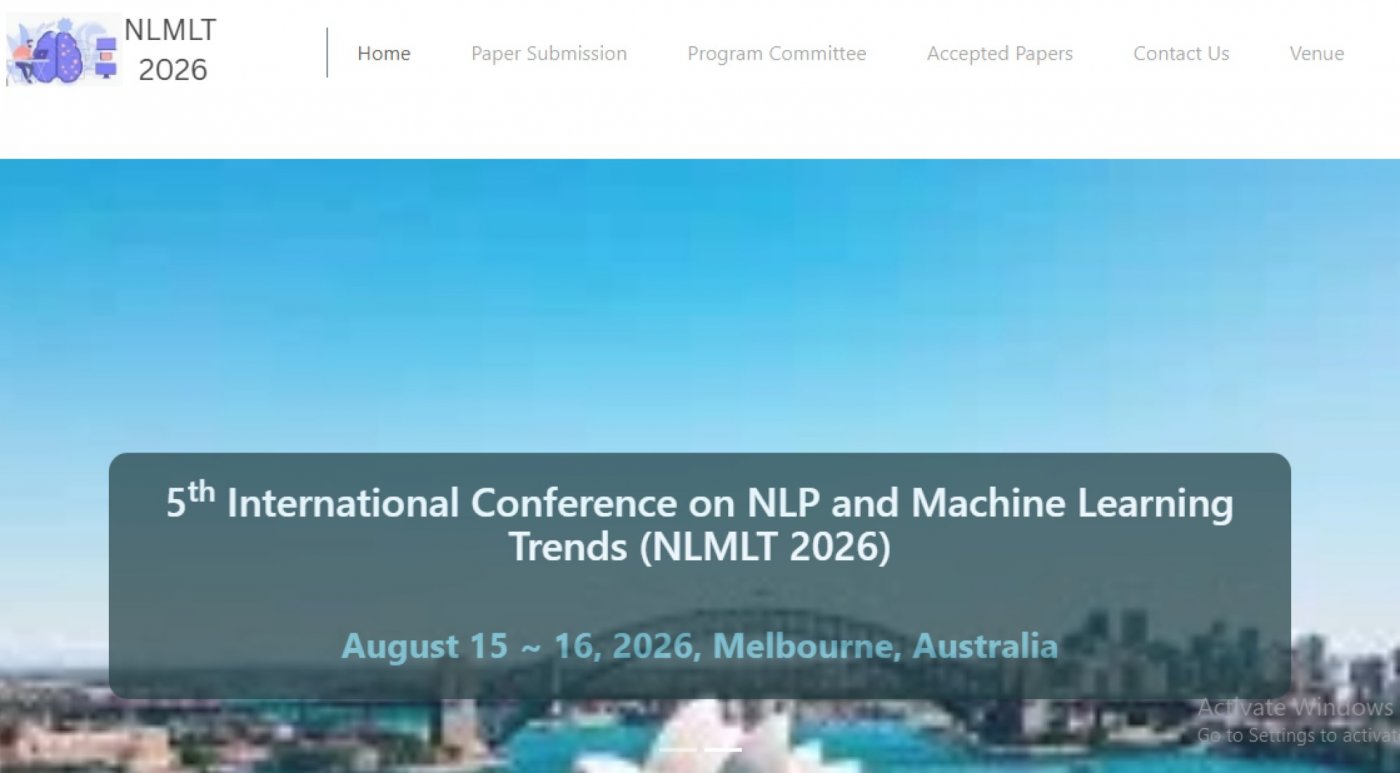
5th International Conference on NLP and Machine Learning Trends (NLMLT 2026)
August 15 ~ 16, 2026, Melbourne, Australia
https://nlmlt2026.org
Scope
The 5th International Conference on NLP and Machine Learning Trends (NLMLT 2026) invites high quality research contributions that advance the rapidly evolving fields of Natural Language Processing and Machine Learning. As foundation models, multimodal systems and efficient learning architectures reshape the landscape of intelligent technologies, NLMLT 2026 provides a global forum for researchers, practitioners and industry innovators to share breakthroughs discuss emerging challenges and explore the next generation of NLP and ML solutions.
We welcome original research papers, survey articles, case studies and industrial applications that highlight significant progress in language technologies, learning algorithms, multimodal intelligence, efficient model design, responsible AI and real world deployment. Submissions may address theoretical foundations, methodological innovations, or practical implementations that push the boundaries of modern NLP and ML.
Authors are encouraged to contribute work related to the conference topics listed below, but submissions are not limited to these areas.
Topics of Interest
Large Language Models, Foundation Models and In Context Learning
- Pre training, fine tuning and instruction tuning
- In context learning (ICL) and meta learning
- Prompt engineering, soft prompts and adapters
- Retrieval Augmented Generation (RAG)
- Long context models and memory architectures
- Alignment, RLHF, DPO and safety tuning
- Hallucination detection and mitigation
- LLM security, adversarial robustness and red teaming
- Tokenizer free and modular language models
- Synthetic data generation, validation and governance
Small Language Models (SLMs) and Efficient Architectures
- Focus on compact, efficient and deployable NLP/ML models
- Small Language Models for edge and on device NLP
- Domain specialized compact models
- Efficient transformer alternatives (Mamba, RWKV, Hyena, S4, etc.)
- Sparse models and Mixture of Experts (MoE)
- Hardware aware optimization for NLP
NLP Tasks and Advanced Language Understanding
- Machine Translation (speech to speech, low resource, multimodal)
- Question Answering and Reading Comprehension
- Summarization (factuality aware, abstractive)
- Information Extraction and Named Entity Recognition
- Sentiment, Emotion and Intent Analysis
- Dialogue Systems and Conversational AI
- Text Generation, Style Transfer and Controlled Generation
- Semantic Parsing, Discourse and Pragmatics
Multimodal and Multisensory AI
- Vision Language Models (VLMs)
- Audio Language Models (ASR/TTS)
- Video Language Understanding
- Multimodal grounding and reasoning
- Embodied AI and interactive multimodal agents
Reasoning, Planning and Neuro Symbolic NLP
- Multi step reasoning and chain of thought modeling
- Tool using LLM agents and autonomous workflows
- Planning augmented NLP systems
- Neuro symbolic reasoning and hybrid models
- Mathematical reasoning and theorem assisted NLP
- Multi agent communication and emergent behavior
Machine Learning Theory and Methods for NLP
- Transformer architectures and sequence modeling
- Representation learning and embeddings
- Self supervised, semi supervised and weakly supervised learning
- Generalization, robustness and domain adaptation
- Continual, lifelong and curriculum learning
- Probabilistic modeling and Bayesian deep learning
- Optimization methods for large scale NLP
Efficient, Scalable and Green NLP
- Model compression, pruning and distillation
- Quantization and low precision inference
- Distributed training and scalable optimization
- Energy efficient NLP systems
- Edge NLP and on device inference
Ethics, Fairness, Safety and Responsible NLP
- Bias detection and mitigation
- Fairness in multilingual and low resource NLP
- Privacy preserving NLP (federated, encrypted computation)
- Trustworthy evaluation and benchmark design
- Safety critical NLP applications
- AI governance, transparency and accountability
Multilingual, Cross Lingual and Low Resource NLP
- Cross lingual transfer learning
- Low resource language modeling
- Multilingual LLMs and translation systems
- Code switching and mixed language NLP
- Typology aware modeling and linguistic diversity
Speech Language Unified Models
- Speech language joint modeling
- Speech to speech translation
- Audio text alignment and grounding
- Spoken dialogue systems
Applied NLP and ML Systems
- Healthcare NLP
- Legal, financial and scientific NLP
- Recommender systems powered by NLP
- Search, retrieval and ranking systems
- Educational NLP
- Social media analysis and misinformation detection
Data, Resources and Evaluation
- Dataset creation, augmentation and curation
- Synthetic data pipelines and validation
- Annotation tools and human in the loop systems
- Evaluation metrics and benchmark development
- Benchmark contamination detection
- Robustness under distribution shift
Paper Submission
Authors are invited to submit papers through the Submission System by August 08, 2026(final call). Submissions must be original and should not have been published previously or be under consideration for publication while being evaluated for this conference. The proceedings of the conference will be published by Computer Science Conference Proceedings in Computer Science & Information Technology (CS&IT) series(Confirmed).
Selected papers from NLMLT 2026, after further revisions, will be published in the special issue of the following journals
- International Journal of Artificial Intelligence & Applications (IJAIA)
- Machine Learning and Applications: An International Journal (MLAIJ)
- International Journal of Ubiquitous Computing (IJU)
- Advances in Vision Computing: An International Journal (AVC)
- International Journal on Natural Language Computing (IJNLC))
- Information Technology in Industry (ITII)
Important Dates
Second Batch : Submissions after April 05, 2026
- Submission Deadline: August 08, 2026(Final call)
- Authors Notification: August 13, 2026
- Registration & Camera-Ready Paper Due: August 14, 2026
Contact Us
Here’s where you can reach us : [email protected] or [email protected]
Where is it happening?
Event Location & Nearby Stays: