28th Arts & Crafts Conference in Western New York: Rochester and Environs
About this Event
In executing the 2025 Arts & Crafts Conference in Central New York, it became clear to IAC that the weight of Movement history and the wealth of Movement expressions in Rochester & environs made compelling a return to New York State in 2026. Rochester was an active center for the Movement in the United States. Critically acclaimed artists such as M. Louise Stowell and Harvey Ellis co-founded the Rochester Arts and Crafts Society in 1897, likely the Nation’s first, predating that in Boston by several months, and contributed significantly to the Movement's growth and educational legacy. Stowell, an instructor at the Mechanics Institute (the forerunner of the Rochester Institute of Technology [RIT]), wrote in 1892 in an article for the Educational Gazette, a periodical for teachers that “Nothing should be careless in ornament or design, but should be faithfully thought out and patiently evolved,” arguably an unsurpassed articulation of the Movement’s ethos.
In IAC's 28th Annual Arts and Crafts Conference, we delve into Rochester, Buffalo and environs, which are rich in expressions of the Arts and Crafts Movement and its ongoing manifestations. Notably, these works were produced in a region of the country that was, and remains, receptive to reform in its many dimensions. We look at buildings and objects, and explore the creative communities, artisan guilds and enterprising firms that produced them, while striving to uncover the ethical and social dimensions of the Movement and their salience for today's culture.
Sites confirmed thus far include(more updates to come):
The George Eastman Estate and Museum
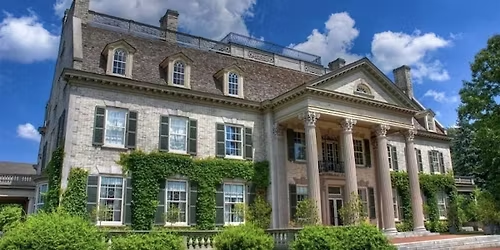
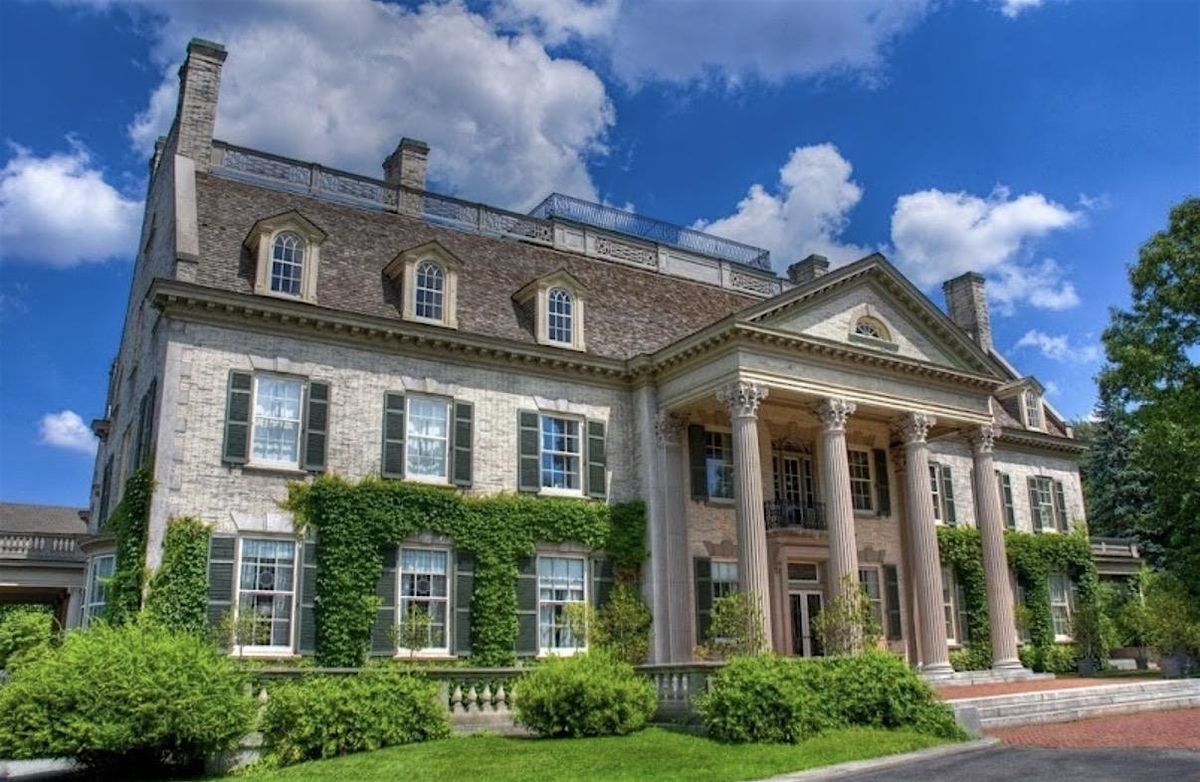
The George Eastman Museum in Rochester, opened to the public in 1949, is the world's first museum dedicated to photography and houses one of the world's oldest film archives. The museum is located on the estate of entrepreneur and philanthropist George Eastman, the founder of Eastman Kodak Company. Kodak was most notably acclaimed for marking a shift in photography from large glass plates to small, 32 mm rolls of film, allowing for a cheaper, more widely accessible method of photography.
The Museum is anchored by the Colonial Revival house (1902 – 1905), commissioned by Eastman, designed by J. Foster Warner, with interiors designed by McKim, Mead & White. The house features a grape arbor, as well as gardens designed by Alling Stephen DeForest and Claude Bragdon.
Grace Episcopal Church
Built in 1885, the church was designed by noted Rochester architect Harvey Ellis in the Latin cross form with prominent Richardsoniam Romanesque elements including rounded apsidal and transept ends topped by conical roofs. The native fieldstone lower level is capped by an upper section of frame construction with a non-structural wall of stained glass. The attached school wing was constructed in 1956 and the square, shingled bell tower was added in 1976.
Genesee Country Village and Museum
A living museum of 19th-century history, this site was conceived and founded in 1966 by art collector John (Jack) L. Wehle. He recognized that the work of regional carpenters, master builders, and housewrights was fast disappearing from the landscape. The museum was to be a village of selected examples of 19th-century Genesee Country architecture that demonstrated not only form but also function, serving as a showcase of the disciplines of cabinetry, weaving, pottery, and other arts that would be displayed in appropriate cultural context.
The Wendell Castle Workshop
The Wendell Castle Workshop is a living institution that celebrates innovation, education, and appreciation for art, craft, and design. For over 50 years, this studio was the creative home of Wendell Castle (1932–2018), one of America's most influential artists and widely recognized as the father of the American Studio Furniture movement. Here, Castle conceived and created virtually all of his masterworks, pioneering an approach to furniture that merged sculpture, craftsmanship, and design.
The Guaranty Building
Unveiled in 1896 and designed by Adler & Sullivan, this early skyscraper boasts intricate terra-cotta facades and strong vertical lines. Louis Sullivan famously pioneered the phrase “form follows function”, arguing that the structure of a building should express its intended purpose. He was inspired by this motto to design steel framed skyscrapers that emphasized verticality and might be seen as expressions of the modern.
The Graycliff Estate
The Graycliff Estate (1931) was designed by Frank Lloyd Wright for Darwin D. Martin, the company secretary of the Buffalo based Larkin Soap Company, and his wife, Isabelle R. Martin, as their summer home on the coast of Lake Erie. The home boasts grand views of the lake and utilizes limestone cut from the very cliffs it sits upon.
The Darwin D. Martin House
With its horizontal lines, rows of windows, open floor plan, and structural connection to the natural landscape, The Darwin D. Martin house (1905) was often considered by Wright to be his “opus”. He viewed it, with the furniture and art glass windows that were also of his design, as an expression of “domestic harmony”. In 2009, a new visitor center was added, designed by the renowned contemporary architect Toshiko Mori, whose work also emphasizes a visual cohesiveness with the surrounding environment.
The Roycroft Campus
The Roycroft Campus was founded in 1895 in East Aurora, NY by Elbert Hubbard, an early champion of the Arts & Crafts ethos in the United States (and a former salesman for the Larkin Soap Company). Inspired by the philosophies of John Ruskin and William Morris, Hubbard aimed to create an artisan community which, as articulated by Ruskin himself, aimed to promote "a belief in working with the head, hand and heart and mixing enough play with the work so that every task is pleasurable and makes for health and happiness". The “Roycroft Campus” includes 14 original buildings, many of which still serve as cultural institutions, educational centers and art galleries.
Rochester Institute of Technology
RIT owes its 1847 founding to the merger of two smaller institutions – the Rochester Athenaeum, an association aimed at “cultivating and promoting literature, science, and the arts”, and the Mechanics Literary Association. In 1950 the institution became home to what is now the School for American Crafts. The university has gone on to build a renowned art and design program, home to many distinguished practitioners, among them esteemed woodworker and furniture designer Wendell Castle who taught and served as an artist-in-residence throughout the latter half of the 20th century. An attestation to the school’s stature and a result of faculty relationships, acclaimed designers Massimo and Lella Vignelli donated their archive to the University in 2010.
Where is it happening?
Event Location & Nearby Stays:
USD 268.61 to USD 1042.24