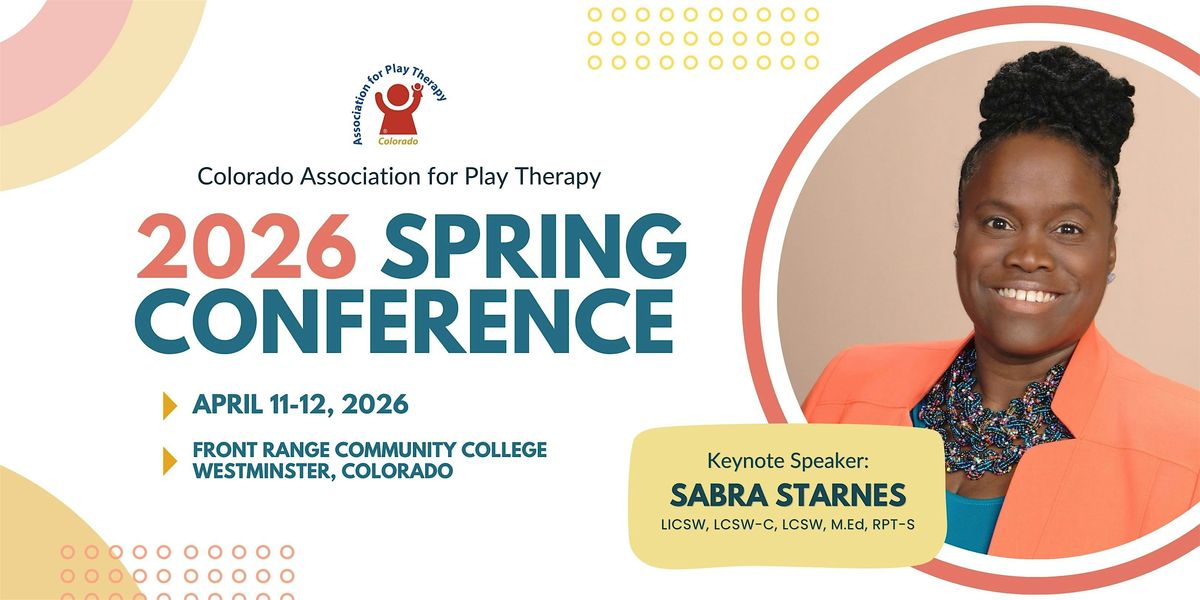
2026 Colorado APT Spring Conference
Schedule
Fri, 10 Apr, 2026 at 08:30 am to Sat, 11 Apr, 2026 at 05:00 pm
UTC-06:00Location
Front Range Community College - Westminster | Westminster, CO
About this Event
Important Information – Please Read All!
We’ve put together all the details you'll need for a smooth and enjoyable experience at the event. Please take a moment to review the full event description for important information on workshops, parking, hotel accommodations, the member’s lunch, and any special discounts available. All the details are right here to help you plan ahead and make the most of your time with us!
______________________________________________________________________________________________________
Members get 25% discount- Please use Promo Code MembersUnite at the beginning on top of the order form.
This ticket is available to current members of the Colorado Association for Play Therapy (CAPT) To enjoy the member rate, be sure your membership is active. The CAPT board will be monitoring membership status of the registrants and may ask for proof of active membership.
Students get a 50% discount- Please use Promo code SmartCookie at the beginning of your order form.
This ticket is available to current students enrolled in programs related to psychology, counseling, social work, or other therapeutic fields. THE CAPT board will be monitoring and may ask for proof of enrolment.
⏰ Early Bird Ends 3/10 — Sign Up Now & Save 10%! ⏰
Time's ticking! Get an extra 10% off when you sign up by March 11th. This special early bird rate won't last forever, so grab it while you can! Don’t wait—secure your spot and save big before prices go up.
Sign up today and lock in your discount!
______________________________________________________________________________________________________
Member’s Lunch
On Saturday April 11, 2026 we’re excited to host a special Member’s Lunch, generously provided by CAPT. This will be a fantastic opportunity to connect and celebrate our play therapy community, and reflect on the incredible journey we've had together. Plus, every member will receive a special gift—but you'll have to be there to find out what it is! If you have any dietary restrictions, please let us know in advance in the order form once you add in the "member's lunch option and we'll be happy to accommodate.
______________________________________________________________________________________________________
How to Register:
Follow these easy steps to complete your registration:
- Apply Your Discount Code (If applicable): If you're a student, use the code STUDENTSRULE, or if you're a CAPT member, use MEMBERSUNITE to receive your discount.
- Choose Your Ticket: Select from our pre‑set ticket options: Keynote, All‑Day Workshop, AM Workshop, or PM Workshop.
You may combine tickets to attend the workshops that best fit your interests. - Add Member’s Lunch (If applicable): If you're a CAPT member, be sure to add the Member’s Lunch to your registration at the bottom of the page so we can accurately plan for the event.
- Select Your Workshop: On the order form, choose the workshop session you’d like to attend and answer any additional questions.
- Complete Your Payment: Finalize your order and pay for your ticket. You will receive a confirmation email once your registration is complete.
It’s that simple—register now to secure your spot!
______________________________________________________________________________________________________
Parking Information:
Free open lot, first come first serve so get there early!
Hotel Reservations:
CAPT has reserved a hotel block with Hyatt Place Denver/Westminster. Please follow the link below to make nessesary reservations for lodging.
Hyatt Place Denver/Westminster
6865 W 103rd Ave
Westminster, CO 80021
Phone: (312) 750-1234
Make Reservations: Hyatt Link
Cut off date: 3/12/26
______________________________________________________________________________________________________
Friday, April 10th
Keynote Presenter: Sabra Starnes LICSW, LCSW-C, RPT-S, M.Ed
Play Therapy for Adoptive Children and Families: Exploring the Seven Core Issues to Foster Healthy Expression, Attachment, and Healing
Play Therapy Skills and Methods | Beginner | 6 CEs
About Sabra Starnes LICSW, LCSW-C, RPT-S, M.Ed
Sabra Starnes, LICSW, LCSW-C, LCSW, M. Ed RPT-S is an experienced trainer, speaker, and owner of Next Place Therapy Services, LLC, a group supporting children, teens, and families through play therapy and trauma-informed care. A sought-after national presenter, Sabra offers engaging, practical training focused on adoption, foster care, cultural humility, and clinical supervision. She creates and designs her own training courses and is an Approved Continuing Education Provider for the Association for Play Therapy (APT), National Board for Certified Counselors (NBCC), and Association of Social Work Boards (ASWB). She is a Certified Daring Way Facilitator with advanced training in Brainspotting, EMDR, Internal Family Systems (IFS), Sandtray Therapy, Theraplay®, and Dyadic Developmental Psychotherapy (DDP). Sabra is also the founder of Next Place Therapy Foundation, a nonprofit supporting adoptees, and adoptive families nationwide. Drawing from her personal and professional experiences as an adoptee and therapist, she specializes in attachment-based and expressive therapies. She holds. degrees from Bennett College, Catholic University, and American University. Sabra is. passionate about providing supervision and mentorship to clinicians and leads training that center connection, resilience, and cultural humility.
Learn more at www.sabrastarnes.com.
Training Overview
Adoption brings unique challenges for children and families, and play therapy offers a powerful way to help them heal and grow. In this training, we’ll dive into the seven core issues of adoption— loss, rejection, guilt/shame, grief, identity, intimacy, and control—and explore how these issues impact emotions and relationships. You’ll learn practical play therapy tools to help children express themselves, build stronger attachments, and work through trauma in a safe and supportive environment. With real-life examples, hands-on activities, and actionable strategies, this training will give you the confidence to support adoptive families on their journey toward healing and connection.
______________________________________________________________________________________________________
Saturday, April 11th | Choose between the following Break-out Workshops
Pick between 1 full day workshop or 2 halfday workshops
Full Day Options | 6 CEs
[S9] Foundations of Play Therapy
Play Therapy Seminal & Historically Significant Theories | Beginnger | 6 CEUs
Linda Klein LPC, RPT-S
Jane Johnson, LCSW, RPT-S
Participants will explore the basic theoretical and ethical foundations of play therapy, and gain practical skills and strategies to work with children in order to begin integrating this modality into their clinical practice through use of video of play sessions, PowerPoint, lecture role play and activities.
Objectives:
- Describe the purpose and benefits of play therapy as a modality of change
- Assess at least three theories of play therapy
- Apply the eight tenants of Child Centered Play Therapy
- Explain the set up and toys required for a play therapy session
- Practice core play therapy skills
- Utilize the stages of play therapy and themes to assess progress in play therapy
- Examine ethical considerations related to the practice of play therapy
______________________________________________________________________________________________________
Half Day Options | 3 CEs
Morning Sessions
[S1] Fostering Connection and Building Healthy Bonds with Transracial Adoptive Families Using Play Therapy.
Play therapy skills and methods | Advanced | 3CEs
Sabra Starnes LICSW, LCSW-C, RPT-S, M.Ed
This will be a 3-hour in-person training course led by Sabra Starnes, a transracial adoptee and adoptive mother. This transformative session, enriched with hands-on activities, videos, and dynamic small and large group discussions, delves into the powerful impact of play therapy. Sabra will share her personal and professional experiences, providing unique insights into the joys and challenges of working with transracial adoptive families. Explore crucial elements such as race, culture, attachment, and family bonds, gaining practical tools for important conversations, improved communication, and enhanced resilience within adoptive families. Learn to create a therapeutic space that embraces diversity and fosters secure attachments, navigating the distinct nuances of transracial adoption.
Objectives:
- Demonstrate play therapy techniques tailored to address challenges in transracial adoptive families, promoting secure attachments and addressing cultural nuances
- Discuss ways for creating a therapeutic space that embraces diversity and navigates sensitive conversations around race and culture in transracial adoption
- Analyze the intersection of play therapy, attachment, and family systems to enhance communication and resilience in transracial adoptive families, contributing to overall family well-being
[S2] Skills, Styles, and Theories, Oh My! A Supervisor’s Guide to Play Therapy Growth
Play Therapy Skills and Methods | Intermediate | 3CEs
Erin Bennetts LCSW, RPTS
Supervising play therapy isn’t just about checklists and case notes. It’s about helping clinicians grow into confident, creative, theory-grounded play therapists. This fun, interactive workshop is designed to refresh your supervision toolkit and reignite your joy for the work. We’ll explore core and advanced clinical skills through both directive and non-directive lenses, play with supervision strategies that honor theory fidelity, and laugh a little along the way. Whether you’re mentoring newbies or guiding seasoned clinicians toward their RPT, this session will help you supervise with more clarity, connection, and play.
Objectives:
- Participants will be able to: Differentiate between directive and non-directive play therapy models recognized by APT, identifying core values and intervention styles within each
- Describe the core and advanced play therapy skills outlined in the APT Play Therapy Competencies, with attention to how these appear in clinical supervision
- Apply supervision strategies that help supervisees develop and demonstrate skills such as tracking, reflection of feeling, limit setting, and theory-consistent treatment planning
- Evaluate supervisees’ ability to integrate theoretical orientation with intervention choice, using competency-based feedback models
- Design playful, theory-aligned supervision activities that support supervisee growth and highlight multicultural awareness and ethical practice
[S3] Narrative-Informed Child-Centered Play Therapy: Witnessing Story, Reclaiming Agency, and Honoring the Inner World
Play Therapy Skills and Methods | Beginner | 3CEs
Lisa Forbes PhD, LPC, RPT
This play therapy training introduces a narrative-informed, non-directive, child-centered approach that honors the child’s wisdom while using narrative concepts to understand, track, and respond to emerging play stories. Participants will learn how to watch play through a narrative lens, listening for implied or internalized stories, tracking embodied storylines, recognizing “cracks” in rigid play sequences, and supporting children as they move toward empowerment and re-authoring. This workshop integrates the therapeutic powers of play, emphasizes post-graduate clinical decision-making, and demonstrates how play itself becomes a systematic healing model that fosters emotional wellness, communication, mastery, and optimal growth.
Objectives:
- Identify three types of emerging narratives in child-centered play therapy (eg Implied/Internalized Story, Embodied Story, Break Free Story) and describe how these reflect the child’s psychosocial needs
- Analyze symbolic play sequences to detect shifts, "cracks,” or narrative openings that signal movement toward emotional wellness, agency, or re-authoring within the play therapy process
- Demonstrate advanced therapist responses—grounded in child-centered non-directiveness—that support narrative development, agency, and healing while maintaining fidelity to the therapeutic powers of play
- Explain how this narrative-informed child-centered model functions as a systematic therapeutic approach that prevents or resolves traumas and stressors and supports growth and development
- Apply narrative-informed case conceptualization to track therapeutic progress across phases of play therapy while maintaining a non-directive stance.
[S4] The Golden Thread in Action: Bridging Therapeutic Insights and Parent Consultations in Play Therapy
Play Therapy Skills and Methods | Intermediate | 3CEs
Sarah Swafford M.Ed.,LPC-S,RPT
Parent involvement is a critical component of Child-Centered Play Therapy (CCPT) and has been shown to significantly enhance therapeutic outcomes. However, many therapists find it challenging to integrate parental concerns and translate playroom observations into consultations that clearly convey treatment goals and progress. This presentation will explore strategies for strengthening the therapeutic alliance with parents while upholding best practices in CCPT. Central to the training is the application of the Golden Thread of Treatment, presented through five practical building blocks that offer a structured framework for analyzing clinical observations and clearly communicating indicators of progress or regression. Participants will gain tools to assess and categorize playroom behaviors, translate these insights into parent consultations, and support parents in understanding their child’s therapeutic journey.
Objectives:
- Apply effective use of the Golden Thread of documentation to demonstrate clinical reasoning in play therapy and ensure optimal level of care 2
- Identify 3 indicators of progression and regression in a child’s behavior and affect throughout the play therapy process
- Analyze playroom behaviors and affect in play therapy to effectively inform and guide ongoing parent consultations
_____________________________________________
Afternoon Sessions
[S5] Integrating Play Therapy and Flash Technique in the 4-Phase Treatment Model for Children & Adolescents with Developmental Trauma Disorder
Play Therapy Special Topics | Advanced | 3CEs
Michele M. Yarberry, LPC, NCC, RPT, BCP3
This workshop is designed for advanced, trauma-informed Play Therapists. Combining Play Therapy and the Flash Technique is an effective way of working with children/adolescents with Developmental Trauma Disorder (DTD) (Van der Kolk, 2005) who do not typically respond to tradition approaches. The Flash Technique is an Eye Movement Desensitization Reprocessing (Shapiro, 1995) Protocol, which was developed by Dr. Manfield who hypothesized three phenomena: “Unreportable” (subliminal) processing, bypassing conscious defenses; Modified memory reconsolidation; Cultivation of a present observer position, rather than reexperiencing” (2020). The protocol is short, easy, and focuses on a positive experience, event, accomplishment, song, etc., and resolution of a traumatic event without distress is often achieved within 5-10 minutes. This workshop will demonstrate the application of the Flash Technique and Play Therapy in the 4- Phase Treatment Model, Stabilization, Trauma Processing, Integration, Post-Integration, with clinical examples that apply and integrate standard principals of treatment and common playful interventions. Alternative ways of therapeutically engaging parents in sessions will be exemplified as well.
Objectives:
- Describe a Playful Positive Engaging Focus 2
- List the 4 Phases of Treatment that Play Therapy and Flash Technique can be applied 3
- Plan for sessions combining Play Therapy and the Flash Technique
[S6] When Parents Weaponize Therapy: Protecting the Child and the Play Therapy Process
Play Therapy Special Topics | Intermediate | 3CEs
Dr. Jaylynne Koch PhD, LPC, RPTS
When parents are in conflict, the play therapist often ends up stuck in the middle—pulled for information, pressured to take sides, or asked to “just tell the court what the child said.” Kids feel it, therapists feel it, and the whole process gets messy fast. This workshop looks at what it’s like when parents start using play therapy as part of the fight instead of part of the healing. We will talk through early red flags all the way to setting clear, realistic boundaries with parents. If you’ve ever felt your stomach drop after an email, parent update, or uncomfortable request, this workshop will give you more confidence, clarity, and tools to stay neutral, ethical, and child-centered no matter how intense the family dynamic becomes.
Objectives:
- Identify at least three observable indicators that a parent may be attempting to weaponize the play therapy process, based on case examples and child behavior patterns
- Describe two ethical, documentation, or confidentiality practices that protect the child’s therapeutic space within play therapy when working with high-conflict or adversarial caregivers
- Demonstrate at least two boundary-setting or communication strategies that maintain therapist neutrality and support child-centered treatment goals within the play therapy setting, as shown through role-play or applied scripting.
[S7] Supporting Sensory Needs and Co-Regulation for Deeper Connection in Play Therapy
Play Therapy Skills and Methods | Intermediate | 3CEs
Julie Reising LMFT, LMFT Supervisor, RPT-S
This experiential workshop explores how nervous system regulation and co-regulation deepen therapeutic connection and strengthen outcomes in play therapy. Participants will learn practical, body-based regulation interventions for use in the playroom while also examining the critical role of the therapist’s own regulation and self-care in maintaining attunement and presence. The workshop highlights how these practices activate key Therapeutic Powers of Play, supporting safety, emotional balance, and meaningful therapeutic change.
Objectives:
- Demonstrate at least three nervous system regulation interventions that can be effectively integrated into the play therapy process to support children’s sensory and emotional needs
- Explain the essential role of body-based co-regulation in promoting healing, enhancing safety, and deepening connection within the play therapy relationship
- Identify the Therapeutic Powers of Play that are activated through body regulation and co-regulation strategies, and articulate how these mechanisms support therapeutic change
- Describe the importance of therapist self-care and nervous system regulation as foundational components for effective co-regulation and sustaining therapeutic presence
[S8] Capturing Lightning in a Bottle: Best Skills & Methods for Ethical Play Therapy Documentation
Play Therapy Skills and Methods | Beginner | 3CEs
Steven L. Parks, LCSW-S, MBA, RPT-S
This experiential workshop explores how nervous system regulation and co-regulation deepen therapeutic connection and strengthen outcomes in play therapy. Participants will learn practical, body-based regulation interventions for use in the playroom while also examining the critical role of the therapist’s own regulation and self-care in maintaining attunement and presence. The workshop highlights how these practices activate key Therapeutic Powers of Play, supporting safety, emotional balance, and meaningful therapeutic change.
Objectives:
- Identify at least five key aspects of Play Therapy sessions that should be documented per ethical and best practices
- Develop a Play Therapy documentation protocol that upholds ethical principles and standards
- Describe two benefits of Play Therapy documentation that align with person-centered theory and case conceptualization
______________________________________________________________________________________________________
Inclusion Scholarship
This scholarship opportunity is open to applicants who identify with diverse ethnic or racial backgrounds. This scholarship will cover the registration cost for one day attendance (up to 6 CEUs) at a CAPT sponsored conference.
Applications for the 2026 Spring conference are due by 5:00pm MST, Febuary 24. 2026. CAPT will review all fully completed and on time applications. Applications will then be de-identified and randomly chosen. Recipients will be notified by email by March 3rd, 2026. Please reply as soon as possible, to confirm acceptance. Since the timeline for this scholarship is right at the early bird discount deadline (March 10th)- If you are not selected for this scholarship and would still like to sign up for the conference- or if you'd like to add day 2 - we will send you a discount code so you can utilize the early registration discount.
This scholarship cycle will be for the Spring 2026 conference - but we'll be opening scholarships back up for each upcoming conference!
APPLY HERE!
______________________________________________________________________________________________________
Additional Information
- No audio or videotaping is permitted.
- Handicapped parking and access is available.
- You must be a member before 04/11/26 to receive member rate
- *APT offers an annual membership, renewable every 12 months, and honors a dual membership system, which ensures all individuals living within a chartered branch territory are members of both APT and their respective branches.
- Join APT and the Colorado branch (CAPT) by going to http://www.a4pt.org/?page=Membership
- To receive CE credit, attendees must complete CE materials, sign in/out daily, and complete an evaluation of sessions attended.
CAPT is a chartered branch of the Association for Play Therapy. The Colorado Association for Play Therapy is approved by the Association for Play Therapy to offer Continuing Education
Play therapy credit is only awarded to mental health professionals
APT Approved Provider 99-049

______________________________________________________________________________________________________
Conference Policies
Eligibility Policy The Annual Spring Conference is open to mental health professionals or full-time graduate students in a mental health field. Although not eligible to receive continuing education credit, allied professionals (pediatricians, nurses, etc.) are welcome to attend. Due to the nature of the topics presented and to ensure the best experience for all attendees, children of any age are not permitted in conference workshops or venues for the duration of the event. CAPT has the right to refuse or cancel ineligible registrations at any time and shall not be held accountable for any outside fees associated with this cancellation. If you have any specific questions regarding your eligibility status, please contact [email protected].
Cancellation Policy
- Registration cancellations are all through eventbrite.
- CAPT reserves the right to cancel this conference in the event of unforeseen circumstances. If such occurs, CAPT will attempt to notify registrants at least 10 calendar days prior to the conference and refund all registration, workshop, continuing education, and tour fees. In all instances, the liability of CAPT is limited to refunding such fees.
Disclaimers
- Registration and participation in CAPT workshops and other activities constitutes an agreement by the registrant to the use and distribution (both now and in the future) of the registrant or attendee’s image or voice in photographs, videos, electronic reproductions, and audiotapes of such events and activities by CAPT.
- The Annual Spring Conference is sponsored by CAPT for educational purposes only. The material presented is not intended to represent the only or best approaches to the topics being discussed and participants waive any claim they may have against CAPT for assurance on information presented.
Unacceptable Behavior
Professional conduct by attendees is expected while attending the CAPT conference and during sponsored events. Examples of unacceptable behavior include, but are not limited to:
- Harassment, intimidation, or discrimination in any form.
- Physical or verbal abuse of any attendee, speaker, volunteer, exhibitor, CAPT staff member, service provider, or other conference guest. Examples include, but are not limited to, verbal comments related to gender, sexual orientation, disability, physical appearance, body size, race, religion, national origin, inappropriate use of nudity and/or sexual images in public spaces or in presentations, or threatening or stalking any attendee, speaker, volunteer, exhibitor, APT staff member, service provider, or other conference guest.
- Disruption of presentations during sessions, in the exhibit hall, or at other events organized by APT at the meeting venue, or other APTcontracted facilities. •
- Presentations, postings, and messages should not contain promotional materials, special offers, job offers, product announcements, or solicitation for services. CAPT reserves the right to remove such messages and potentially ban sources of those solicitations.
- CAPT has zero-tolerance for any form of discrimination or harassment, including but not limited to sexual harassment by participants or our staff at our meetings. If you experience harassment or hear of any incidents of unacceptable behavior, CAPT asks that you inform CAPT Board members, at [email protected] so that we may take the appropriate action. CAPT reserves the right to take any action deemed necessary and appropriate, including immediate removal from the conference without warning or refund, in response to any incident of unacceptable behavior, and CAPT reserves the right to prohibit attendance at any future conference.
______________________________________________________________________________________________________

Friday Keynote
🕑: 08:30 AM - 09:00 AM
Check-in & Registration
🕑: 09:00 AM - 05:00 PM
Keynote | Play Therapy for Adoptive Children and Families
Host: Sabra Starnes LICSW, LCSW-C, RPT-S, M.Ed
Saturday Breakouts
🕑: 08:30 AM - 09:00 AM
Check-in & Registration
🕑: 09:00 AM - 12:15 PM
Morning Breakout Sessions
🕑: 12:30 AM - 01:30 PM
Members Lunch
🕑: 01:45 PM - 05:00 PM
Afternoon Breakout Sessions
Where is it happening?
Front Range Community College - Westminster, 3645 West 112th Avenue, Westminster, United StatesEvent Location & Nearby Stays:
USD 0.00 to USD 513.00