Visit to Annesley Hall Gardens & Pleasure Grounds

About this Event
Important information
Parts of the site are very overgrown and the ground may be uneven in places. Please dress appropriately for the conditions and wear sturdy footwear. The hall and its associated buildings are under repair and must not be entered. No toilet facilities are available at the site.
Background
Annesley Hall and its Park have their origins in the 13th Century. The first hall was built in the latter half of the C13 by the Annesley family, and a deer park of 60 acres was created in 1327 to the NW of the hall.
All Saints' church (C12 and later, listed grade I, scheduled ancient monument) is located immediately to the north of Annesley Hall and is surrounded by a walled churchyard.
The estate passed by marriage into the Chaworth family during the mid C15. By 1610 the hall had been rebuilt by George, first Viscount Chaworth, who probably laid out the terraces and orchard shown in the engraving below. The hall was extended in 1691, there were further modifications in the C18, and a north wing was added in the 1860s
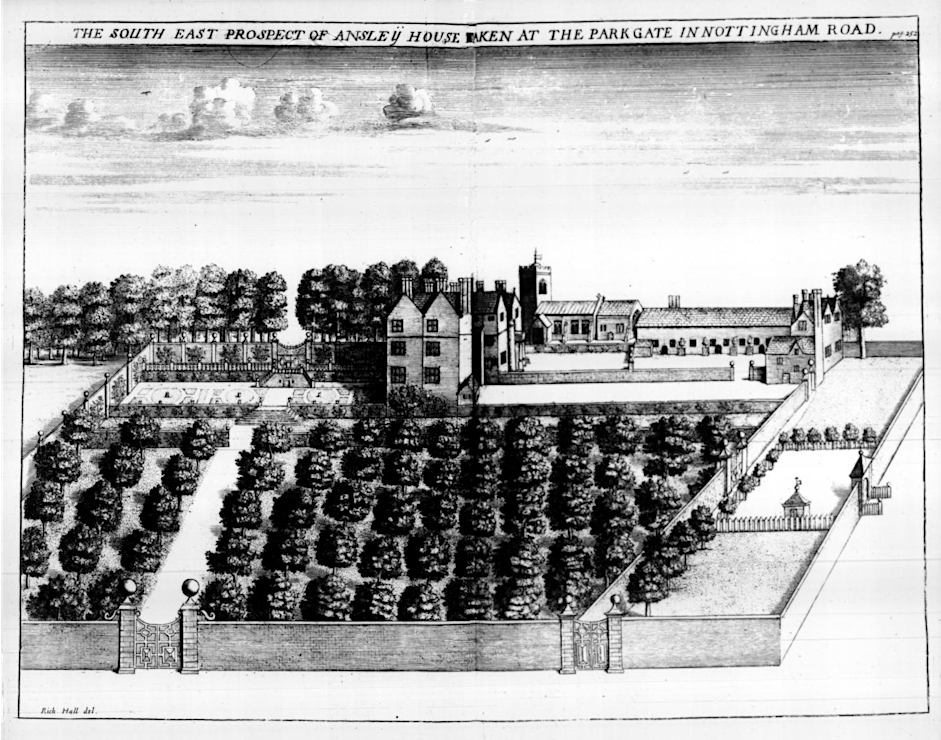
Engraving published in , from an illustration by Richard Hall
Our visit
The C17 terraces survive, along with pleasure gardens laid out during the C19, though parts have become very overgrown.
A flavour of what remains is given by the following extract from a description published in the Journal of Horticulture and Cottage Gardener (13 April 1876), pp 288-90:
The principal entrance to the Hall is through an archway into a large open courtyard, bounded on the north side by stables, carriage houses, and other outbuildings; the east by offices, laundry, dairy, game larder, &c.; and the south side is open to the park.
As we left the courtyard I noticed just in the boundary of the park two fine specimens of Fern-leaved Alders. From the front door round to the western side of the Hall is a broad border filled with spring-flowering plants in the ribbon fashion, consisting chiefly of Daisies, Crocuses, Polyanthuses, Hepaticas, Stachys lanata, Aubrietia, Violas, and Pansies.
Ascending a flight of steps we reach the bowling-green; it was on this beautiful sward that Byron during his visits to Annesley used to practise pistol-shooting. Another double flight of steps brings us to the upper terrace, from which we obtain splendid views of the surrounding country. The front of the terrace is ornamented with quaint balustrading, and the wall on the opposite side [of] the broad pavement has the appearance of living festoons.
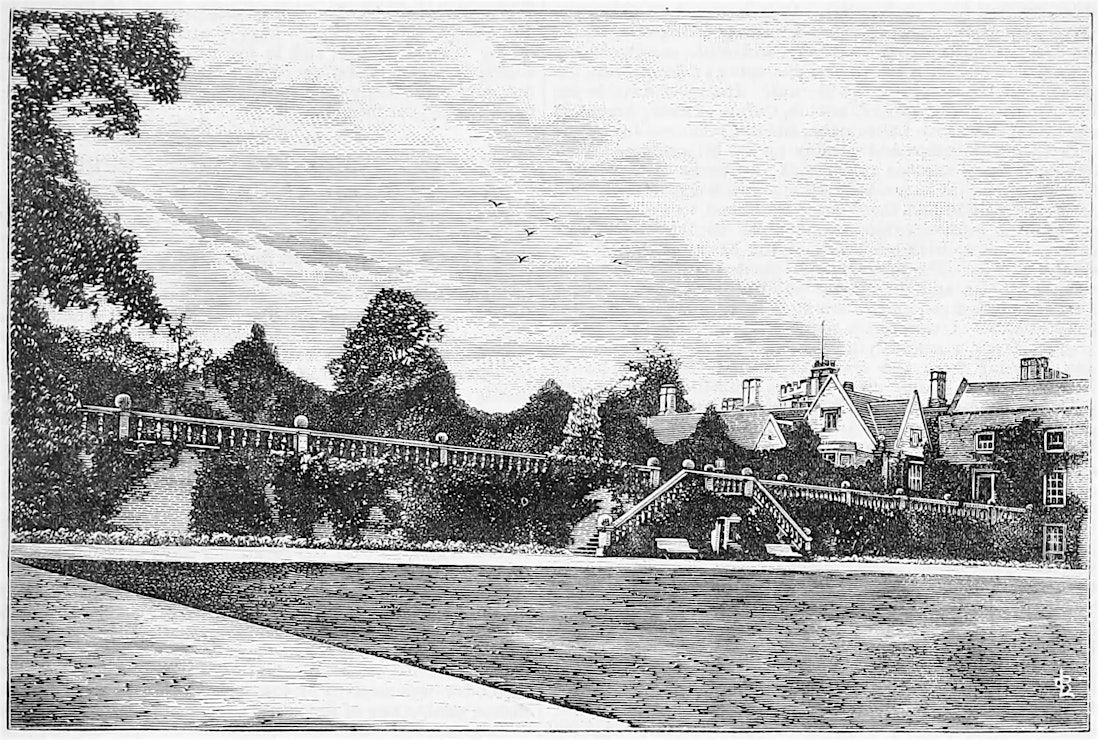
As we emerge [to the south-west] from the terrace we pass down a large flight of steps, and leaving the Hall behind us we pass by beds of Rhododendrons, with some venerable Elms, Limes, and Sycamores in the rear. Numerous walks intersect the pleasure ground, and in places where the surface is considerably elevated the walks traverse through cuttings about 5 or 6 feet deep. Instead of the grass sloping down to the margin of the walks the sides are built up with rockwork with large cavities between the stones, in which are planted Aubrietias, Arabig, Iberis, and other gay spring flowers.
As we pass along one of these walks every step is full of interest. Several very fine evergreens are in luxuriant health, such as Pinus excelea, 70 feet round the extremity of its branches and 25 feet high; Cedrus deodara, 70 in circumference and 25 feet high; a very fine Wellingtonia; also Cedar of Lebanon and atlantica, a fine pyramid of Hodger's hybrid Holly, Thujopsis borealis, and Hemlock Spruces.
At the end of this walk we come to an open space from which other walks diverge in different directions. Here is planted in the centre a large Wellingtonia on a high mound, with a bordering of Berberis aquifolia. Down a number of steps in a secluded glen I noticed what formerly was the village well, and from it emerges a tiny stream which spread out between banks of Laurels and Rhododendrons, forming a miniature lake.
Turning to the left I just take a glance up one of the long glades close to the boundary of the park which forms the pinetum. Near the iron fence is a long line of Yews planted about 20 feet from each other. It is intended to allow the upper branches to meet and form a series of living arches. On the other side of the avenue Pinuses and other evergreens are in excellent health, perfect pyramids many of them, with the lower branches sweeping the ground.
Retracing our steps and passing by the before-named Wellingtonia along another rustic walk, we come to the spring flower garden. It is enclosed with a Yew hedge 4 feet high. At intervals of 20 feet the Yews are allowed to grow and are cut into the form of pyramids. A broad border 12 feet wide runs all round, with rockwork at the back for Alpine and similar plants.
The plants used for the embellishment of this garden might be counted by thousands, and when in their full glory must be seen to form any idea of their exquisite beauty. As we leave this spot of pleasant associations we travel towards the kitchen garden. This is separated from the pleasure grounds by a broad belt of grass with a gravel walk in the centre 10 feet wide. On the right there is a Yew hedge 4 feet high, with pyramids 25 feet apart and about 12 feet high.
Passing through a pair of iron gates we come into the kitchen garden. It is two acres inside the walls and one acre outside, and the orchard is three acres and a half. The pleasure grounds including the terraces are fourteen acres.
The walled kitchen garden lies west of the pleasure grounds, outside the area of the registered park and garden. It is now in use by an equestrian...
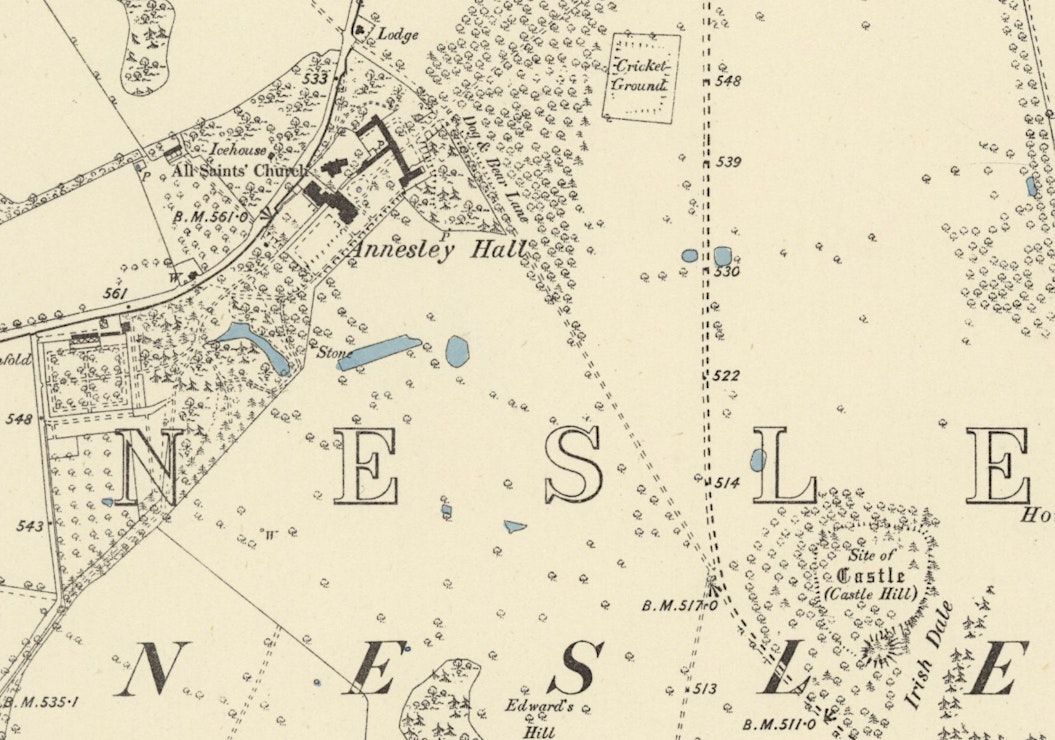
Extract from Ordnance Survey 6" map sheet Nottinghamshire XXXII.NE, published 1886
Reproduced with the permission of the National Library of Scotland
Agenda
🕑: 06:40 PM - 06:55 PM
Arrival
Info: Please ensure that you arrive on time as the gates will need to be locked while we explore the site
🕑: 06:55 PM - 07:00 PM
Introduction
Info: Once we've assembled on site there will be a short introduction to the history and layout of the estate
🕑: 07:00 PM - 08:30 PM
Explore the site
Info: We plan to start by visiting the 17th Century terraces, which provide sweeping views across the historic park to the south. After a brief foray into the C19 garden area to the north, we will then proceed into the area of the pleasure gardens, where we hope to identify some of the features described in the 1876 article.
Where is it happening?
Event Location & Nearby Stays:
GBP 10.00