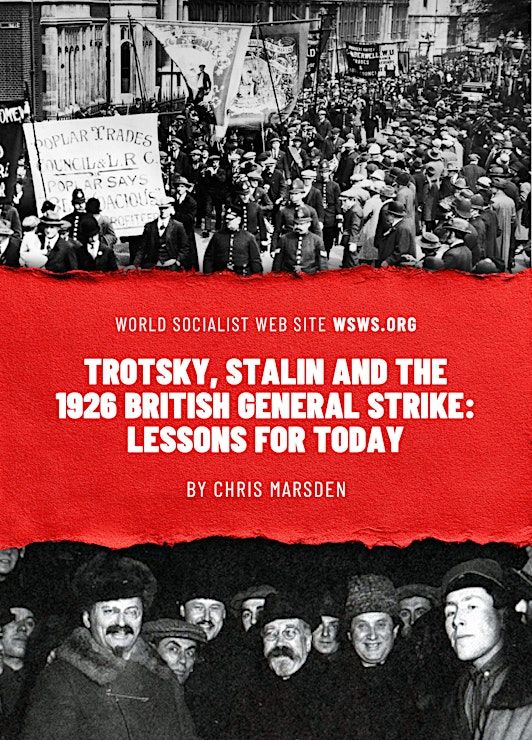
Trotsky, Stalin and the 1926 General Strike: Lessons for Today
Schedule
Sun May 31 2026 at 02:00 pm to 05:00 pm
UTC+01:00Location
Premier Inn Glasgow City Centre (George Square) hotel | Glasgow, SC

About this Event
There are few more bitterly contested and less clearly understood historical experiences than the general strike of 1926, despite it being a decisive moment in the history of the British and international working class.
Begun on May 3 and lasting nine days, it was the first and remains the only general strike ever to have taken place in the UK.
The action was launched in response to a massive attack on the wages of Britain’s 1.2 million coal miners, amid a period of widespread labour unrest. The Trades Union Congress (TUC), which oversaw the strike, worked to bring it to an end, succeeding on May 12 and enforcing a crushing defeat.
This pamphlet contains two lectures delivered by Chris Marsden, the National Secretary of the Socialist Equality Party: “Stalin, Trotsky and the 1926 British general strike” from 2007, and “Trotsky and the British General Strike of 1926” delivered in September 2025.
The lectures explain the origins of the strike in the profoundly revolutionary consequences of the decline of British imperialism and its eclipse by the United States, and the political impact of the Russian Revolution of October 1917. No longer able to grant economic concessions to preserve social peace, Britain’s ruling elite determined to take on and defeat the miners as the most powerful section of the working class.
The general strike was the response by the working class to this offensive and had a potentially revolutionary character—objectively posing the fundamental question of which class is to rule society. What was absent in this situation, however, was the subjective factor: a party dedicated to the pursuit of socialist revolution with a clear perspective for taking power.
The lectures examine in detail the role played by the architects of the defeat: the trade union and Labour bureaucracy that led the working class and for whom revolution was anathema—which is why the TUC has never allowed another general strike to be called in the past century.
Crucially, the workers were not betrayed by the overt right‑wingers alone, but by the left trade union bureaucrats, who used radical rhetoric to keep the rank‑and‑file tethered to the TUC apparatus. It was the “lefts” that acted as the final line of defence for the capitalist state.
This is an essential lesson for today, with figures such as Jeremy Corbyn, Zarah Sultana, Zack Polanski of the Greens, and their trade union counterparts still using militant and “progressive” rhetoric to manage political and social discontent while systematically suppressing the class struggle.
What distinguishes these lectures from the slew of commemorative articles and books on 1926 is that the general strike is examined primarily from the standpoint of the disastrous line pursued by the Communist Party of Great Britain (CPGB) under the direction of the Communist International, led by Joseph Stalin and his allies.
This appraisal rests on the writings of Leon Trotsky, leader of the revolutionary opposition to the Stalin faction, and therefore provides a genuinely Marxist assessment of the strike and its defeat.
Trotsky’s critique of how the potential for a revolutionary confrontation between the British working class and the Conservative government of Stanley Baldwin was squandered by the Comintern leadership explains that the key mechanism of the strike’s betrayal was the Anglo‑Russian Committee, which had the support of many of the trade union “lefts”.
Under the Comintern‑inspired slogan, “All Power to the General Council”, the leaders of the National Minority Movement in the trade unions, organising over a million workers, allowed the TUC to lead the strike to defeat.
Stalin’s line, Marsden summarises, was based on:
- Deep skepticism about the possibility of revolution, as evidenced by his assertion of a new period of capitalist stabilization.
- A turn away from the task of building the Communist Party in favour of opportunist alliances with the trade union bureaucracy.
- The assertion that these forces could eventually be pushed to the left by militant pressure and act as a substitute for the party.
- The abandonment or diminution of criticism of Moscow’s allies, at least of the lefts, and a refusal to draw any practical conclusions even when it became impossible to remain silent.
The 2025 lecture, utilising recently published internal discussions of the general strike within the Communist Party of the Soviet Union’s political bureau, makes clear the political link between the defeat of 1926 and the nationalist bureaucratic degeneration of the Communist Party of the Soviet Union (CPSU, the former Bolshevik Party), embodied in Stalin’s theory of “Socialism in One Country”.
Trotsky explained that had the small and only recently formed CPGB been armed with a correct political line, this would not have been a guarantor of success, let alone of the revolutionary overthrow of British capitalism. But it would have massively weakened the grip of the Labour and trade union bureaucracy over the working class, strengthened the authority of the CPGB and paved the way for subsequent revolutionary struggles.
Instead, as the second lecture demonstrates, the betrayal of 1926 was part of a series of political disasters and betrayals of an ever more fundamental character that saw the transformation of the Third International under the Stalinist bureaucracy into a conscious agent of counterrevolution—and which ensured the survival of imperialism and paved the way for fascism and world war.
The lessons of 1926 still resonate today. The degeneration of the trade union bureaucracy and of the old reformist parties is now complete. The trade unions have become hollowed‑out corporatist syndicates, which abandoned even a limited defence of their members’ social interests with the onset of globalisation in the 1980s.
The Labour Party of Keir Starmer is a naked party of the financial oligarchy, dedicated to the destruction of what remains of the welfare state and the imposition of savage austerity, and an accomplice to genocide and US‑ and NATO‑led imperialist wars.
The crisis confronting British and world imperialism is far worse than it was in 1926. The social position faced by the working class is desperate, fascist and far‑right movements are on the rise and humanity is being dragged ever closer to disaster by a series of wars, now centred on Iran, that threaten a global conflagration.
Under these circumstances, opposition in the working class to the betrayals of the unions must become an active political and organisational break with them, with workers’ rank‑and‑file committees seizing control from the bureaucrats.
This requires above all else a new political perspective, programme and leadership.
The lesson of the 1926 General Strike is that militant struggle alone, especially when directed to pushing the bureaucratised organisations to the left, is a road to defeat. An independent, internationalist, socialist and revolutionary party must be built to lead the renewed movement of the British and world working class emerging in response to the social offensive and political crimes of the ruling class.
This pamphlet is a weapon in the construction of that leadership—the Socialist Equality Party, British section of the International Committee of the Fourth International.
Order here: https://bit.ly/1926-General-Strike
Where is it happening?
Premier Inn Glasgow City Centre (George Square) hotel, 187 George Street, Glasgow, United KingdomEvent Location & Nearby Stays:
GBP 3.00 to GBP 10.00