The Roots of Agriculture in America (Winter Course)
Schedule
Tue, 13 Jan, 2026 at 06:00 pm to Tue, 03 Mar, 2026 at 07:30 pm
UTC-05:00Location
Pennsylvania Horticultural Society | Philadelphia, PA

About this Event
WAGNER FREE INSTITUTE OF SCIENCE – WINTER 2026 COURSE: BOTANY SERIES
The Roots of Agriculture in America with Professor Karen Snetselaar
6 Tuesdays from January 13 - February 17, 6:00 - 7:30 PM
Location: This course meets at the Pennsylvania Horticultural Society, located at 100 N. 20th Street in Philadelphia.
This course requires pre-registration. Separate registration is required for each student. Sign up here or call 215-763-6529 x14 for assistance.
Course Description
In recognition of the 250th anniversary of the signing of the Declaration of Independence, this course will explore the roles of key crops in American colonial history. Beginning with an introduction to agriculture in North America before 1776, each week will focus on one or more colonial-era crops that had significant economic, social and cultural impacts on Americans and American history. The course will consider both indigenous crops and plants introduced by people who came to the Americas voluntarily and involuntarily.
Course Schedule
1. Tuesday, January 13, 2026 – Introduction and the First Thanksgiving
The American origin story often includes accounts of a romanticized 1621 harvest celebration involving early colonists known as the Pilgrims and American Indians who helped them survive their first year in Massachusetts. For a more realistic account of the relationship between colonizers and the Wampanoag and other nations in the region, you can watch historian David Silverman’s presentation at the American Philosophical Society (
). The class will discuss some of the realities leading up to—and following—the 1621 celebration, which were far more complex than the familiar narrative suggests. The event also serves as a jumping-off point to summarize what we know about important plants in the early days of the colonial period in America.2. Tuesday, January 20, 2026 – Indigenous staples: Maize
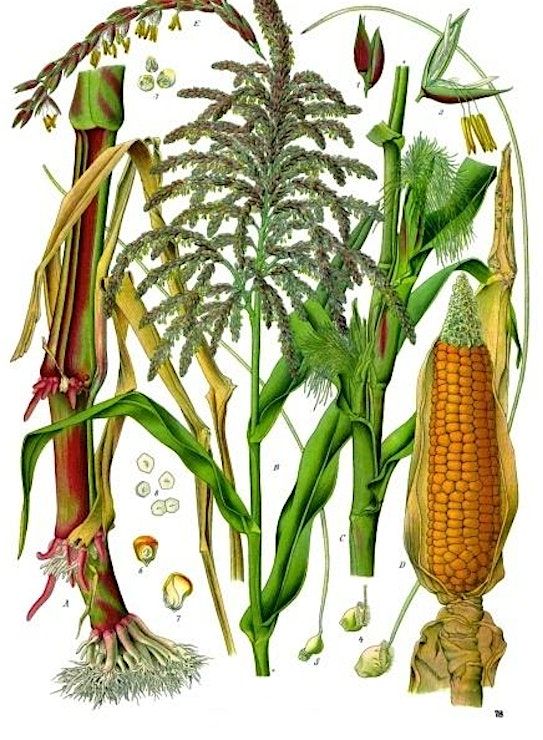
Mayflower passenger Edward Winslow reported in 1621 that while the first-year pea crop failed and the barley was “indifferent,” the “Indian corn” crop was successful. It is generally believed that the Pilgrims would not have survived their first few years without learning to grow this plant. The history of maize starts in southern and central America some 9,000 years ago, and researchers are still discovering how the plant came to spread all across the Americas. This story is still being written: maize (corn) remains the dominant U.S. crop in terms of both yield and acreage. For a nuanced and inclusive account of how maize is entwined with our colonial history, read “Corn Tastes Better on the Honor System” by Robin Wall Kimmerer.
3. Tuesday, January 27, 2026 – Important crops from Europe: Apples
Without barley, it was difficult for New Englanders to brew beer, their drink of choice. Another European crop, however, thrived in the colonies—apples. Native crabapple species were very sour; while they could be used to make cider, they weren’t as useful as the European species colonists brought with them. The myths about Johnny Appleseed grew from the activities of a real person whose life, in some ways, epitomized colonial westward migration during and after the American Revolution. There are many books about him. The first few chapters of Michael Kerrigan’s Johnny Appleseed and the American Orchard provide a good account of the apple’s history in America prior to the Revolutionary War. It is available electronically at no cost through some libraries.
4. Tuesday, February 3, 2026– Indigenous cash crops: Tobacco
Considering its entire history, it is difficult to imagine a more controversial colonial crop than tobacco. This session focuses on the pre-colonial and colonial history of tobacco growing. For a quick overview, this summary by park ranger Lee Pelham Cotton is hard to beat: Tobacco: The Early History of a New World Crop. https://www.nps.gov/jame/learn/historyculture/tobacco-the-early-history-of-a-new-world-crop.htm. It was published by the National Park Service in 1998.
5. Tuesday, February 10, 2026 – Important crops with African connections: Rice
Enslaved Africans were among the earliest colonists in America. They brought not only their food traditions but actual crop species with them. In the colonial period, some enslaved people spent time in the Caribbean or in Europe before being taken to North America. Tracing how these crops became established is difficult, obscured by the chaos and violence of the transatlantic slave trade and the direct and indirect routes by which they arrived. The history of rice cultivation in America provides a revealing example. This engaging article describes some of that uncertainty: https://www.scseagrant.org/carolinas-gold-coast-the-culture-of-rice-and-slavery/. We will also discuss additional complexities, including the fact that African and Asian rice species can interbreed and their genetic relationships remain unclear.
6. Tuesday, February 17, 2026 – Transition from agrarian to global mercantile economy: Cotton
While the Founding Fathers often spoke eloquently about the virtue of farms and farming, many were wealthy men who made much of their money from commerce. From the earliest colonial period, cash crops—crops grown primarily for sale and export—played a central role in the American economy. These included tobacco, indigo, rice, and sugar. The success of these crops depended on slavery and the plantation system because of the tremendous labor requirements. Cotton did not become a major crop until the 19th century, but it was grown in colonial America and is interesting because of its global distribution. This chapter from a textbook by textile historian Charlotte Jirousek provides a concise explanation of textiles in colonial America, including cotton: http://char.txa.cornell.edu/ppeamericatex.htm
Suggested Reading
There is no textbook for the course. Lists of relevant readings and links to online resources are given in the schedule above. Additional resources may be provided in an updated syllabus at the beginning of the course.
The country’s founding fathers had strong opinions about the importance of agriculture to American independence and they envisioned a nation of farmers. The book Founding Gardeners. The Revolutionary Generation, Nature and the Shaping of the American Nation, by Andrea Wulf, is an engaging and rigorous treatment of how Washington, Jefferson, Franklin and others viewed early American agriculture. It serves as a nice introduction to the topic. The book is available in the PHS library.
About the Professor
Dr. Karen Snetselaar is Professor Emeritus of Biology at Saint Joseph’s University. She has been a member of the faculty of the Wagner Free Institute of Science since 2000. Her research focuses on fungi and plant disease. She is also interested in urban ecology and in promoting public understanding of science, especially science education outreach into K-12 schools. For 20 years, she led the Wagner’s partnership with Saint Joseph’s University, GeoKids LINKS, which brings intensive science learning into North Philadelphia schools.
FAQs
What is the cost?
Wagner courses are free; donations are encouraged!
Are there minimum age requirements to enter the course?
The adult lecture courses are offered on an introductory college level. They are open to anyone seeking an introduction to various areas of the sciences as well as those familiar with the subjects who wish to broaden and update their knowledge. The courses also provide an excellent opportunity for motivated junior high and high school students to supplement their current science courses and to help prepare them for further study in these fields at a college level. The courses are appropriate as well for teachers seeking to expand their knowledge.
What are my transportation/parking options for getting to and from the course?
The Pennsylvania Horticultural Society is located at the northwest corner of 20th and Arch Streets in Center City. It is convenient to multiple public transportation routes. The closest trolley stop is at 22nd and Market Streets. The location is also accessible via multiple bus routes and regional rail lines. There is on-street parking on the surrounding blocks, and multiple paid parking options, including a lot at 19th and Arch Streets.
Is the building wheelchair accessible?
Yes
How can I contact the organizer with any questions?
Click the "Contact the Organizer" link, email [email protected], or call 215-763-6529 x14.
Images:
Top - Waldemar Brandt, Unsplash, unsplash.com/photos/green-grass-nCQXxsSg3oo.
Bottom- Franz Eugen Köhler, Köhler's Medizinal-Pflanzen, Public domain, via Wikimedia Commons
Where is it happening?
Pennsylvania Horticultural Society, 100 North 20th Street, Philadelphia, United StatesEvent Location & Nearby Stays:
USD 0.00