See Rochester's newest art gallery | subsector | FREE

About this Event
- invites you to visit Rochester's newest commercial art gallery, , and meet its gallerist.
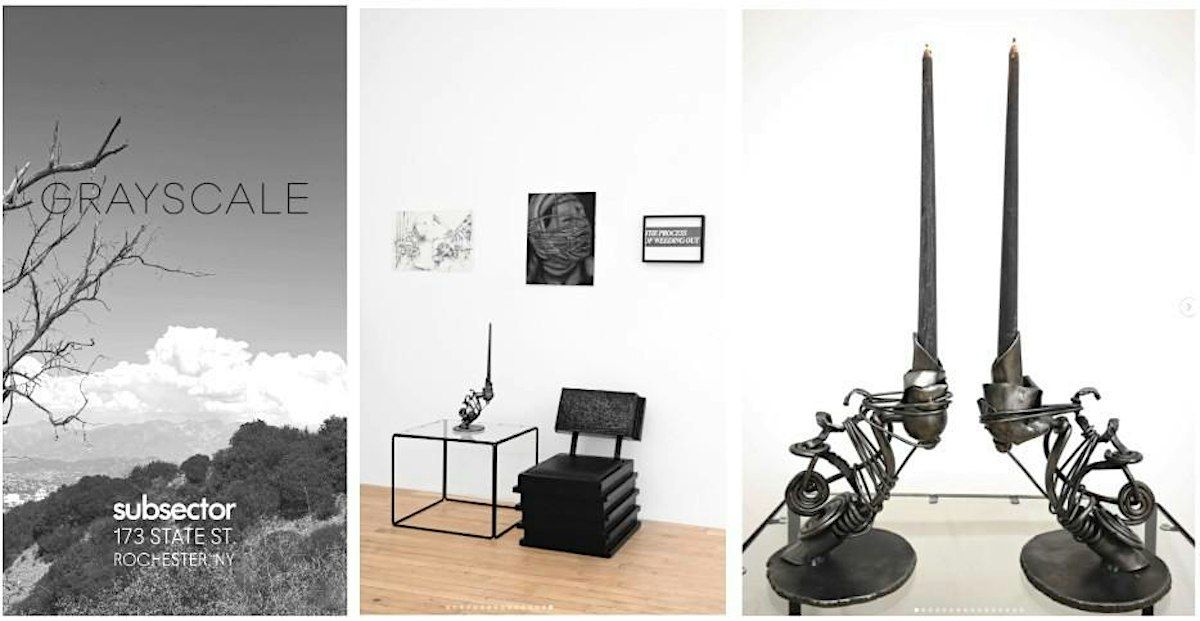
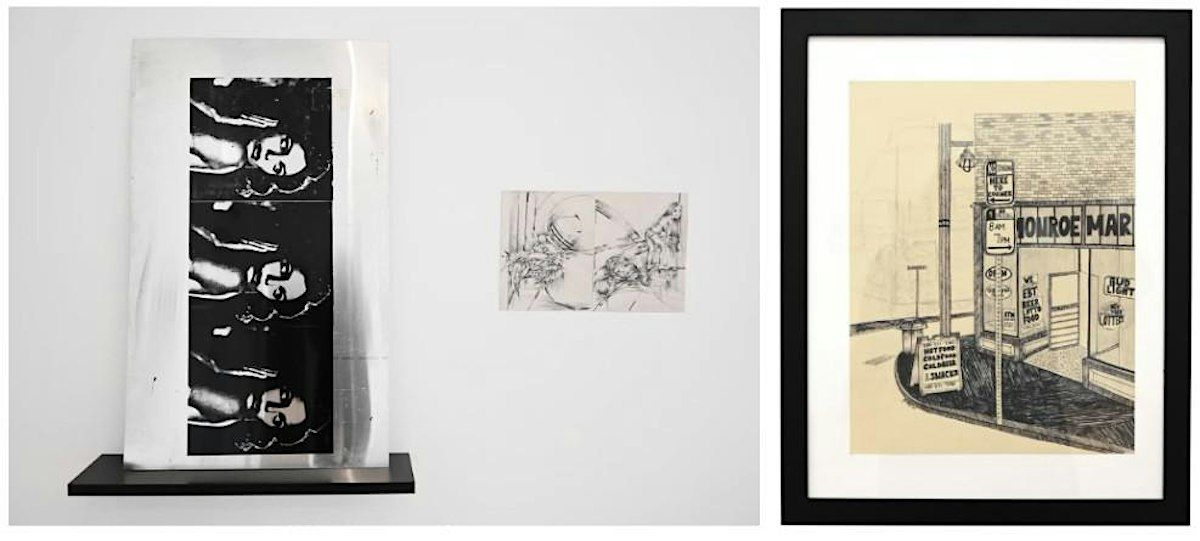
- You will be immersed in GRAYSCALE, a group art exhibition that includes dozens of art works created by fourteen artists.
- Learn about ™, the pairing of new technologies with an array of services designed by a local entrepreneur to help art collectors safely document and share their collections. Attendees of the event will be offered FREE trial access to ™.
Event Schedule & Program Description
2:00 pm until 2:30 pm - Social Mixer
Take the first 30 mintues to walk through GRAYSCALE and chat with other attendees.
2:30 pm - Welcome & Introduction
Rome Celli , founder of will welcome attendees and introduce gallerist, Matthew Tully Dugan. Tully will talk briefly about why he openned and offer insights about a selction of works found in GRAYSCALE.
2:45 pm - Protecting, Preserving and Sharing Your Art Collection with
Rome will then introduce Michael Molaire. Michael will provide a brief overview of the services and technology that power ™.
==========
The event is FREE and open to the public but attendees must register in advance here on Eventbrite.
Parking is FREE, convenient and plentiful. . (This parking map link will be shared with registered attendees again in an email 48 hours before the event.)
You do not have to be a member of to attend.
Artists exhibiting in GRAYSCALE:
- Gianpaolo Alexander
- Annalisa Barron
- Jaylen Cooper
- Matthew Tully Dugan
- Cody Goebl
- Naim Johnson
- Gary Katiya
- Nandi Loaf
- Bobby Morebed
- Mr. Liz Hopkins
- Luke O'Halloran
- Stephanie Perez
- Michael St. John
- Sonja "Sonny" Rosario
- Nick Sethi
- Theadora Sutherland
- Valentina Vaccarella
- Banks Violette
About GRAYSCALE
GRAYSCALE includes works by 18 artists, all presented in desaturated mediums ranging from painting and drawing to digital media, collage and sculpture. Despite their material differences the works all speak to the insistence of the artist to reproduce images. Be it for study or thesis, the inclination persists through an artist's career to re-articulate what the world around them sounds like in their voice, describing experience through their personal language of art making. This desire to share in the documentation of our individual realities was something Eastman Kodak saw early on - the first portable camera was designed and produced by Kodak in Rochester in 1888 leading to the development of roll film and the $1 "Brownie" camera in 1900 which made it possible for the everyday person to photograph their own "Kodak Moments" . This democratization of photography was perhaps the primary source of the undercurrent that's led us to our current state of image obsession, further reinforced by Kodak's invention of the first self-contained digital camera in 1975 which undoubtedly led us to a revolution of self-serve image production. These pioneering developments led to a shift in American culture, creating new actors out of what was once an audience, bringing entertainment media into the home allowing us the ability to capture our own lives on film like Hollywood producers.
In 1959 another elemental component of DIY art production would also arise from the post industrial city of Rochester, the Xerox copier. Armed with these tools the artist was now able to self-publish and distribute written text as well as images. The Fluxus artists of the 60s and 70s adopted the xerox machine as a primary tool in the creation of their anti-establishment manifestos, similarly deconstructing boundaries of art production which aimed to dismantle the institutional hierarchy of the art world and its reliance on commercially commodifiable objects. The authorship and valuation of artworks themselves soon became the topic of discourse with the Pictures Generation, artists like Sherrie Levine, Sarah Charlesworth and Richard Prince began to interrogate the significance of the "original" establishing philosophies which gave greater significance to the interpretation of ideas in contrast to the Modernist ideals which had laid their stake in the importance of the artist's ability to create a totally new idea. But historically the re-production has always reigned supreme in an artist's oeuvre - Renaissance painters like Raphael Sanzio trained by learning to render the works in the style of their mentors. By the end of their time together it was said the hand of Pietro Perugino and his apprentice Raphael could not be distinguished from one another. This was true for many of the Old Masters that came to succeed their predecessors by way of stylistic appropriation, the nuance of which came from each artists' reinterpretation of that system of painting into their own gesture. Prior to photographic tools the artist had to rely on their optical accuity, training the hand to depict the range of value that we collect with our vision. Charcoal studies establish value in a sketch that articulates the source of light in a composition which allows the artist to render a scene before them in real time. This charcoal sketch acts as the "plate" of a painting and gets developed through a system of layers that distinguishes light and dark in what is known as a Grisaille; the grayscale underpainting that creates the value beneath a color glazing.
Although these means of capturing an image seem vastly unrelated the nature of each relies on the perception of light. In digital space light is merely a simulation. This is also true of the imagination. In order to imbue a sense of realness to these production methods the light is inferred through memory and reference. The light is developed by what the artist has come to understand about their perception of light in the real world to make an approximate photocopy of the mind's eye. Sometimes that light is a reference to a beloved artwork that captures a moment that resonates with the artist.
A new wave of photographic reproduction has inundated the post-internet generations. Memetic redistribution of images has become a universal means of discourse online. While once considered disingenuous, constructed or aestheticized sameness has become accepted as part of our contemporary vernacular and memes are the currency through which people establish identity by a reification of that image's subtext exclaiming, "This is so me". Context and POV are presented through the use of images and their underlying implications creating a social impetus to "know the reference" without necessarily insisting that comprehension is derived from the original but moreso from the ability to understand the reinterpretation of that reference. Art making has in turn begun to discuss the importance of the original in an age that is so digitally advanced that the once science fiction parameters of artificially created intelligence is now a daily recalibration of perception. Ai imaging acts like our imagination in that it is composed of an endless bank of references all being prioritized to meet our expected outcome through precise prompts developed by the user. In time it is believed this technological tool will be able to emulate life itself, biomorphically evolving computer processing into organic hosts that are able to utilize human sensory perception to evaluate the world around them, collecting snapshots of its reality to understand its circumstantial existence.
A coalescence of the natural and digital worlds may be forming where the original is no longer able to be distinguished from its copy, but the blueprint will always exist in grayscale: the architecture underneath the embellishment, the code beneath the UI, the daylight burned onto film, the alchemy of silverpoint on gesso, the hand laid copy., these are the tools of truth, the documents of the real, the transpositions of the sublime.
-Matthew Tully Dugan
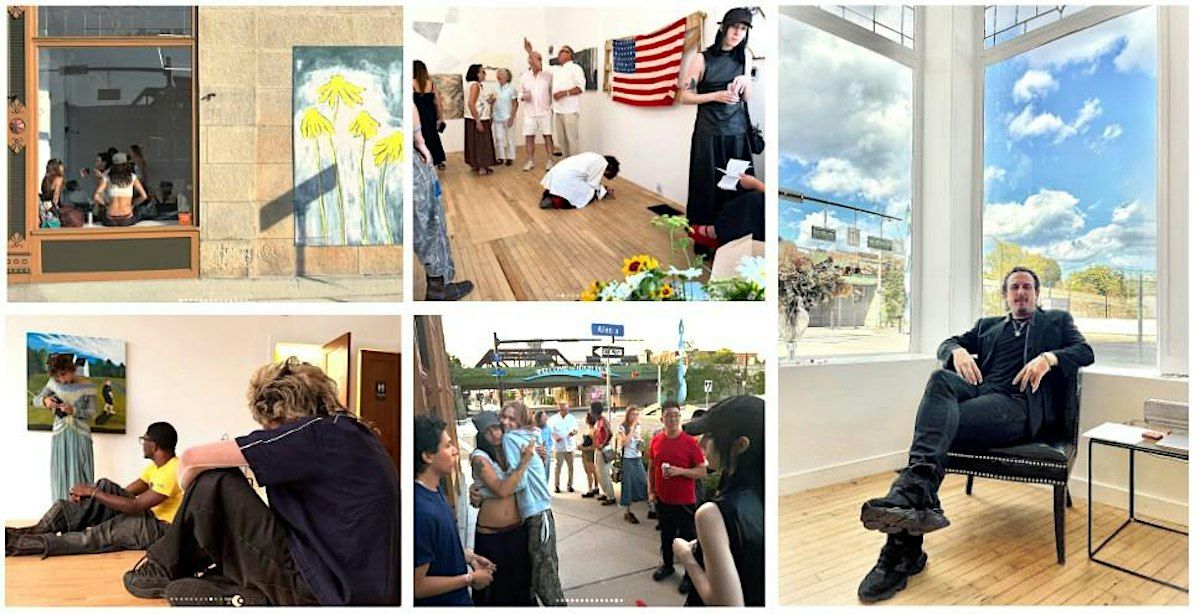
about
is a super-clean, white cube commercial art gallery that celebrates a downtown vibe imported directly from NYC. And when we say, "celebrates" we mean it. - led by it's founding gallerist, Matthew Tully Dugan - knows how to throw a party. He loves inviting artist friends from The City to rock the scene.
You can't understand without getting a feel for Tully Dugan. Tully is a downtown staple of the NYC art scene. Not long ago he threw an American Psycho-themed dinner at 56 Henry St (Lower East Side near Chinatown) set against the backdrop of his Kendall Jenner paintings that riff on Warhol's Jackie O series. Ever since people have been hooked on his keen eye and his antics.
Tully is first-of-all a visual artist and he's got an impressive portfolio to prove it. When you meet him, though, you'll be struck by his capacity for verbal expression. The words come fast and thick. A child of creatives, he developed his vision and entrepreneurial energy while growing up in a leafy eastern suburb of Rochester.
For those who've been following the local art scene for the past few years, is located steps down from where the UUU Gallery and the Spirit Room were lcoated. The Biltmore Bar & Lounge openned earlier this year below Love Hate Tattoo in that stretch of State Street. So, the area has a reputation for attracting strong creative energy.
Tully developed the gallery's first couple of group exhibitions thematically around a strong curatorial vision - culling from works he'd already seen as well as inviting artists to make new works based on his ideas. Artists based in NYC, Rochester and other locations are invited to contribute. GRAYSCALE includes three Rochester-based artists.
Where is it happening?
Event Location & Nearby Stays:
USD 0.00