Scaling Up & Down: Screening for Eco-Social Realism

About this Event
Scaling Up & Down
An Eco-Social Realism Screening
At Ulises 1525 N American St Studio 104, Philadelphia, PA 19122
Saturday, November 14, 2026 5-7:30 p.m.
Featuring Laurie Palmer, David Scott Kessler, Lize Mogel, and Brian Holmes & Jeremy Bolen
Scaling Up & Down moves between works exploring the pasts and futures of large-scale regional watersheds and low-growing primitive organisms like moss and lichen. Following the screening there will be a discussion with the artists moderated by Dylan Gauthier (Visiting Assistant Professor, Bi-Co Department of Environmental Studies).
This program is part of Eco-Social Realism curated by Daniel Tucker and is supported by Cantor Fitzgerald Gallery at Haverford College’s The John B. Hurford ’60 Center for the Arts and Humanities.
About the Work
Jeremy Bolen & Brian Holmes
If This River Could Move, 2023
(TRT: 17:38)
The film traces the relationship between modernist engineering, colonial histories, and ecological transformation along the Mississippi River. Beginning at Old River Control in central Louisiana, it examines the infrastructure designed to regulate the river’s course alongside the enduring colonial structures embodied by Angola Pr*son. These histories converge within the contemporary crisis of coastal land loss and environmental degradation. The film draws on a conversation with Dr. Ibrahima Seck of the Whitney Plantation Museum, situated in the region known as Cancer Alley, and follows the Mississippi downstream toward the Gulf of Mexico. Through landscape, infrastructure, and historical testimony, the film considers how systems of environmental control remain entangled with histories of extraction, racial violence, and colonial power.
The video is accompanied by the online map, Hourglass River (hourglass.rivertoday.org/). Both works were developed in collaboration with the Max Planck Institute for the History of Science and the Mississippi River Open School for Kinship and Social Exchange.
Jeremy Bolen & Brian Holmes
Jeremy Bolen is an artist researcher, organizer and educator interested in site specific, experimental modes of documentation and presentation. Much of Bolen’s work involves rethinking systems of recording –– in an attempt to observe invisible presences that remain from various scientific experiments and human interactions with the earth’s surface. Bolen lives and works between Chicago and Atlanta, serves as Assistant Professor of Photography at Georgia State University, is a co-founder and co-organizer of the Deep Time Chicago collective, and is represented by Andrew Rafacz Gallery, Chicago.
Brian Holmes is a polyglot essayist, artist and researcher. After working with radical movements in France for twenty years, he “returned” to the utterly foreign environment of Chicago.There he began working on political ecology and map-making, while helping to found territorially oriented groups like Compass and Deep Time Chicago. Today he helps animate Watershed Art & Ecology, one of the innumerable artist-run spaces that keep the city alive for queers, freaks and the non-normative.
David Scott Kessler
Excerpts from A Soft Bed Waits, 2026
(TRT, 20:00)
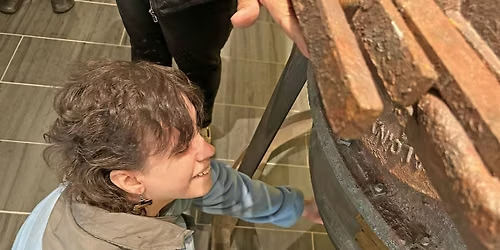
A Soft Bed Waits is an experimental feature-length documentary currently in production. The film's macro lens and magnifying-glass optical system create a shared perceptual field between moss and the human world, holding both in unstable relation. The work maintains both planes in simultaneous clarity, reorganizing scale and orientation. Within this field, Bill Buck, Curator Emeritus of the New York Botanical Garden, kneels among the moss, seen upside down, his face hovering centimeters above it. He spent fifty years studying moss alongside his husband, a lichenologist. Conversations shift between taxonomy and memory, between moss and the lives shaped around it. Morphology turns to reflections on the life they built and the spiritual questions that arose after his husband's death. Guided by these encounters and by moss itself, the filmmaker is visible — setting up the system, negotiating the inverted image, conducting the experiment of sustained attention on himself first. The film records transformation in process, uncertain of its outcome.
David Scott Kessler is a Philadelphia-based filmmaker and visual artist working across documentary, 3D animation, painting, and video installation. His work, characterized by stillness and hidden moments of magic, grows from sustained observation of place, often alongside scientists and local communities. His feature documentary The Pine Barrens premiered at Rooftop Films and won Best Documentary at the New Jersey Film Festival and the Emerging Filmmaker Award at the Princeton Environmental Film Festival. In 2022, he produced The Pine Barrens Project at the Academy of Natural Sciences. In 2015, he received a Pew Fellowship in the Arts and a Flaherty Film Seminar Fellowship. A Pew Residency Fellowship later placed him at Fogo Island Arts, and he has held residencies at the Sitka Center for Art and Ecology and in Taiwan, Sicily, and Iceland. He produced and co-curated Middle of Nowhere, a site-specific series in the New Jersey Pinelands. His animated short Welcome to Low-Level Radioactive Waste Storage Site is being presented in the Institute of Contemporary Art's Open Video Call. His current film, A Soft Bed Waits, is supported by the Philadelphia Independent Media Fund through Scribe Video Center.
Lize Mogel & others
The beginning after the end, 2026
(TRT, 10:10)
Selections from a collective video project in which Mogel invited people to imagine and enact speculative futures, post-climate apocalypse, for the Wallkill River in upstate NY. Some videos were produced in “Liquid Future” workshops as part of the Wallkill Futures project, which Mogel initiated. Video-makers are: Gretchen Burger, Eliza Evans, Matthew Friday, Leilani Gonzales, Alex Harris, Bobby Howe, Cosmo Huang, Howard Huang, Rosa Huang, Jesse McDonald, Claudia Mogel, Gretta Mogel, Lize Mogel, Nancy Novacek, Michelle Rosenberg, Paul Lloyd Sargent, Suzanne Thorpe, Sarah Warren, Ava Wentworth, Kaylee Wentworth. The full set of videos are at vimeo.com/showcase/12305812
Lize Mogel is an interdisciplinary artist and counter-cartographer. She creates maps and mappings (among other forms) that bring the politics of place to the surface. Her work reflects the complicated, human and non-human experience within a place; and also engages people in the myriad potentials of that place. She’s created projects about public parks in Los Angeles, territorial disputes in the Arctic, and wastewater economies in New York City. She is co-editor of the book/map collection “An Atlas of Radical Cartography,” a project that significantly influenced the conversation and production around mapping and activism. From 2016-2024, her focus was Walking the Watershed, a long-term engagement with the landscape, history, and politics of New York City’s water supply, and the relationship between the City and the mostly rural communities that supply its water. Her recent project “Wallkill Futures” was a two-year engagement with the Wallkill River and riverine communities in upstate New York. More about her work is at publicgreen.com
Laurie Palmer
Title: Apple Tree
(TRT: 10 minutes)
A surprising, immersive encounter with collectivity, difference, and abundance on a Monday morning.
“…considerate of all the threatened and delicious things joining one another…this is the world…in which we wander without becoming lost.” — E. Glissant
A. Laurie Palmer is an artist, writer, and teacher. Her research-based work focuses on undoing and re-crafting human practices of relating with the material world towards building just, livable, and joyful social and environmental relations. Palmer also works in collaboration with activist groups in campaigns that employ imagination and art to resist and interrupt injustice and to envision new worlds. She taught in the Sculpture Department at the School of the Art Institute of Chicago for 20 years, and 10 years in the Art Department at the University of California, Santa Cruz, where she helped her colleagues build the Environmental Art and Social Practice MFA program. She has shown her individual and collaborative work nationally and internationally for many decades; recent projects include solo show Soulstorm at Watershed Art & Ecology in Chicago (2024), participation in the group exhibition Natural Death at the Mendocino Art Center (2025), and publication of The Lichen Museum book with the University of Minnesota Press (2023).
About the Moderator:
Dylan Gauthier (he/him) is an artist, curator, and educator whose work centers on listening as practice, method, and politics, and on fostering exchanges with the more-than-human world. Working across sound, text, performance, video, sculpture, and architecture, he develops research-based and collaborative projects that explore the ecological, social, and historical conditions of compromised sites. Gauthier’s work draws on deep listening, acoustic ecology, and field-based research to attune to hidden narratives within landscapes, and to imagine more just, interdependent futures. Gauthier’s solo and collective projects have been exhibited at the Centre Pompidou, Parrish Art Museum, Brandywine Museum of Art, CCVA at Harvard, the Walker Art Center, and ISCP, among other venues in the US and abroad. His writing on art, public space, and environmental imaginaries has appeared in Contemporary Art Stavanger, Urban Omnibus, Parrish Art Museum, and Routledge/Public Art Dialogue. He has held residencies and fellowships with the International Studio and Curatorial Program (as NEA Ecological Artist-in-Residence), Socrates Sculpture Park, Brandywine Conservancy, Shandaken: Storm King, and Eyebeam. He co-founded the boat-building and publishing collective Mare Liberum; the Sunview Luncheonette, a cooperative space for art and communalism in Brooklyn; and, with Mariel Villeré, Freshkills Field R/D, an artist-research residency at New York City’s former landfill. From 2018–2022, he was Director and Chief Curator at the Elizabeth Foundation for the Arts Project Space in NYC. Gauthier is currently Associate Curator at More Art, Research Director for the Wright-Ingraham Institute, and is a Visiting Assistant Professor in Environmental Studies at Haverford College.
Where is it happening?
Event Location & Nearby Stays:
USD 0.00