“Rivers without return”
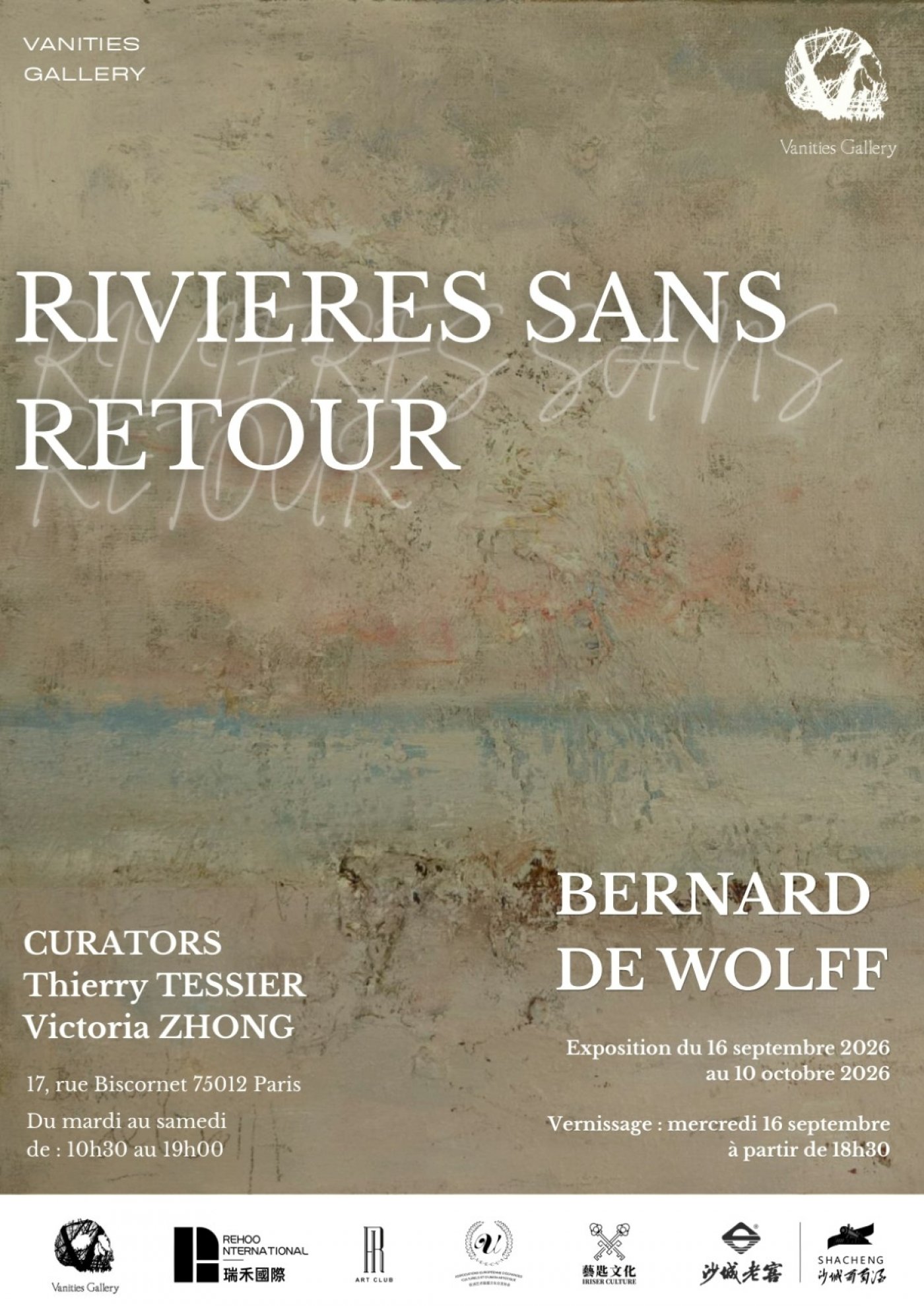
“RIVERS WITHOUT RETURN”
Solo Exhibition
16 September – 10 October 2026
Private View: Wednesday 16 September, from 6.30 pm
Vanities Gallery presents Rivers Without Return, an exhibition of oil paintings by Bernard De Wolff.
The Seine, the Yangtze, the memory of the rivers of the Amazon: a Dutch painter based in Paris accumulates colour in layers so dense that they can take years to dry. He calls this his “Braille painting”.
A PAINTING TO BE READ OBLIQUELY
One must begin with what is seen before anything has been understood: the materiality. In Bernard De Wolff’s work, oil is not a means of representation but a deposit. Layers are superimposed, covered and thickened until they form a relief that catches the raking light and, depending on where one stands, reveals two different paintings.
“Oil paint lives, it has an effect that other materials do not have.”
The phrase is the artist’s own, and it should be taken quite literally: some of his canvases are still drying.
The name he gives to this practice — “Braille painting” — is more paradoxical than it might initially appear. Braille is a form of writing that can only be read through touch; a painting is precisely the object one is not meant to touch. De Wolff therefore creates a tactile form of writing reserved exclusively for the eye, transferring to the viewer the task of deciphering it: to read, one must move, trace the work from one side to the other, and allow light to perform the work that fingers would otherwise undertake.
One is reminded of his academic training — art history and classical archaeology at the University of Amsterdam — a discipline in which one learns that the surface of an object is already its narrative, and that wear and erosion can reveal as much as the image itself.
WHAT THE TITLE IMPLIES
Rivière sans retour is the French title of Otto Preminger’s 1954 film River of No Return. The borrowing is by no means decorative. De Wolff counts Buñuel, Fellini, Eisenstein, Visconti and Godard among his masters, and constructs his paintings as though they were cinematic shots, complete with an unseen space beyond the frame.
Yet the title above all articulates a physical law. A river is defined by the impossibility of returning to it. Leonardo da Vinci observed: “The water you touch in rivers is the last of that which has gone and the first of that which comes; so it is with the present time.” [1]
De Wolff’s impasto obeys the same principle. Once a layer has been laid down, it is not withdrawn: it is covered. The painting is written through alluvium, like a riverbed, preserving within its thickness the memory of all its previous states, while making none of them recoverable.
In the strict technical sense, it is a painting without pentimenti.
LINEAGES: BEYOND THE IMPRESSIONIST LABEL
Guardi (1712–1793) and the Impressionists are certainly present, but what De Wolff takes from them deserves closer consideration.
From Guardi, he does not retain the veduta, the city as portrait; rather, he retains the tocco, that broken brushstroke which reduces passers-by to commas of matter and entrusts the sky with more of the work than the architecture itself.
From Impressionism, he retains not so much its luminosity as its persistence: painting the same motif until the motif itself gives way.
Two less frequently invoked genealogies illuminate this practice more precisely.
The first is Dutch and riverine. Johan Barthold Jongkind (1819–1891), the Dutchman who settled in Paris, painted the Seine and its quays before anyone else; Monet regarded him as his “true master”. Jan Voerman (1857–1941), who remained in Hattem, spent his life painting the IJssel from the same window — one river, painted a thousand times.
De Wolff, a Dutchman living in Paris since 2010, occupies precisely this position: that of the foreigner who teaches a country to see the light of its own waters.
The second is the genealogy of paint itself. Here one must name Eugène Leroy (1910–2000), whose figures eventually become engulfed beneath the material to such an extent that they can only be found by searching for them, and Leon Kossoff (1926–2019), who loaded his views of London until they acquired the weight of masonry.
In all three artists, thickness is not an effect: it is time made visible.
There remains a third direction, one which the artist himself explicitly acknowledges and which cannot be incidental in a gallery engaged with the Chinese art scene: the tradition of ink wash painting, rooted in the Tang dynasty (618–907) and developed by painter-monks, from Mu Qi (1210–1269) to Sesshū (1420–1506) — the art of allowing emptiness to work, and of capturing essence rather than resemblance.
That the same painter should claim both the heaviest impasto and the most economical ink may seem contradictory. It is not. They are two ways of refusing description.
THE INSTALLATION
The exhibition brings together panels measuring fifteen centimetres square, painted on board, alongside canvases exceeding 1.20 metres.
Three rivers run through the exhibition, representing three continents: the Seine (La Seine, Vue on rue Royale), the Yangtze (Yangtze River with Birds), and the Amazonian memory of the years the artist spent in Suriname, where he built a house in the forest.
One motif recurs throughout the work: the bridge — the only human construction that contradicts the law of the river, the only place where one may cross without being carried away.
BERNARD DE WOLFF
Born in Amsterdam, Bernard De Wolff studied art history at the University of Amsterdam from 1982 to 1988, specialising in classical archaeology, cultural anthropology, aesthetics and the philosophy of culture.
After several years producing video material for the Allard Pierson Museum, he devoted himself to painting during the 1990s and exhibited in the United States, where he also lectured on landscape painting.
He subsequently spent almost ten years living in Paramaribo, Suriname. He has been based in Paris since 2010.
[1]
“L'acqua che tocchi de' fiumi è l'ultima di quella che andò e la prima di quella che viene. Così il tempo presente.” Quoted in The Literary Works of Leonardo da Vinci (1883).
The thought ultimately derives from Heraclitus, transmitted through the doxographical tradition (Plato, Cratylus 402a), and subsequently echoed by Seneca (Letters to Lucilius 58.23): in idem flumen bis descendimus. The most probable immediate source, however, is Ovid’s Metamorphoses, Book XV, in the speech of Pythagoras: ut unda impellitur unda… sic tempora nostra fugiunt, in which one wave driving another explicitly becomes an image of time.
Where is it happening?
Event Location & Nearby Stays:
