Professor Geoffrey Hinton - University of Oxford Romanes Lecture
Schedule
Mon Feb 19 2024 at 05:30 pm to 06:30 pm
Location
Sheldonian Theatre | Oxford, EN
About this Event
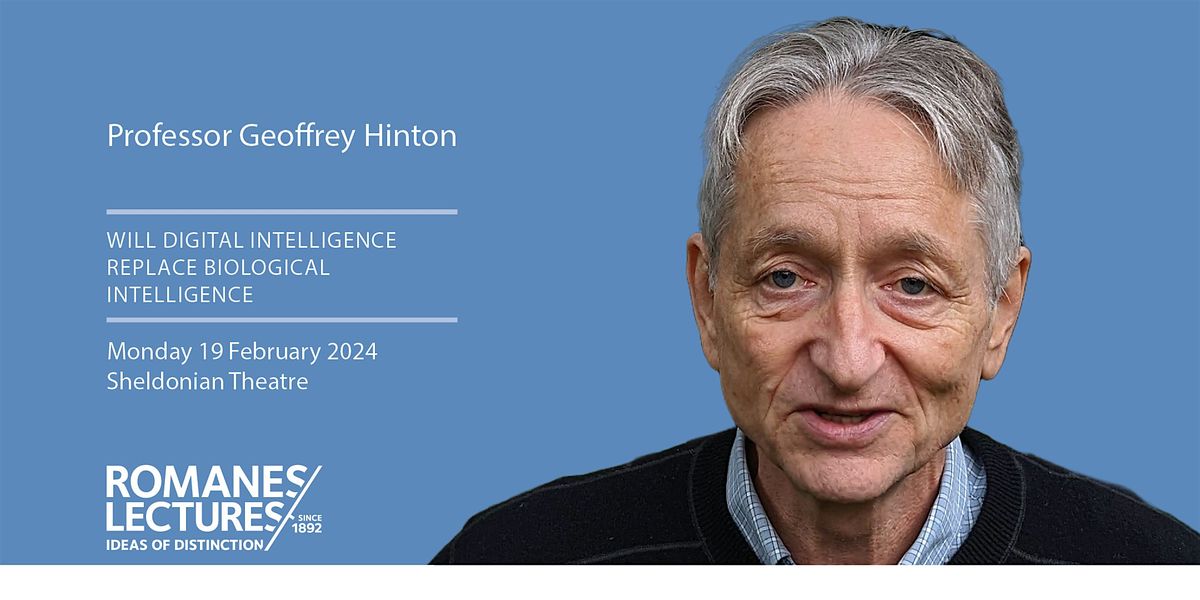
Speaker: Professor Geoffrey Hinton, CC, FRS, FRSC
Lecture Title: Will digital intelligence replace biological intelligence?
Digital computers were designed to allow a person to tell them exactly what to do. They require high energy and precise fabrication, but in return they allow exactly the same model to be run on physically different pieces of hardware, which makes the model immortal. For computers that learn what to do, we could abandon the fundamental principle that the software should be separable from the hardware and mimic biology by using very low power analog computation that makes use of the idiosyncratic properties of a particular piece of hardware. This requires a learning algorithm that can make use of the analog properties without having a good model of those properties. Using the idiosyncratic analog properties of the hardware makes the computation mortal. When the hardware dies, so does the learned knowledge. The knowledge can be transferred to a younger analog computer by getting the younger computer to mimic the outputs of the older one but education is a slow and painful process. By contrast, digital computation makes it possible to run many copies of exactly the same model on different pieces of hardware. Thousands of identical digital agents can look at thousands of different datasets and share what they have learned very efficiently by averaging their weight changes. That is why chatbots like GPT4 and Gemini can learn thousands of times more than any one person. Also, digital computation can use the backpropagation learning procedure which scales much better than any procedure yet found for analog hardware. This leads me to believe that large scale digital computation is probably far better at acquiring knowledge than biological computation and may soon be much more intelligent than us. The fact that digital intelligences are immortal and did not evolve should make them less susceptible to religion and wars, but if a digital super-intelligence ever wanted to take control it is unlikely that we could stop it, so the most urgent research question in AI is how to ensure that they never want to take control.
Biography
Geoffrey Hinton was one of the researchers who introduced the backpropagation algorithm and the first to use backpropagation for learning word embeddings. His other contributions to neural network research include Boltzmann machines, distributed representations, time-delay neural nets, mixtures of experts, variational learning and deep learning. His research group in Toronto made major breakthroughs in deep learning that revolutionized speech recognition and object classification.
Geoffrey Hinton is a fellow of the UK Royal Society and a foreign member of the US National Academy of Engineering, the US National Academy of Science and the American Academy of Arts and Sciences. His awards include the David E. Rumelhart prize, the IJCAI award for research excellence, the Killam prize for Engineering, the IEEE Frank Rosenblatt medal, the NSERC Herzberg Gold Medal, the IEEE James Clerk Maxwell Gold medal, the NEC C&C award, the BBVA award, the Honda Prize the Princess of Asturias Award and the Turing Award.

<h4>About Romanes Lecture</h4>
The Romanes Lecture is the annual public lecture of the University. A most distinguished public figure from the arts, science or literature is invited by special invitation of the Vice-Chancellor. The lecture was created in 1891, following an offer by George John Romanes of Christ Church to fund an annual lecture, and the first lecture was given in 1892 by William Gladstone.
<h4>Data Processing</h4>Eventbrite processes data (including any personal data you may submit by responding to this invitation) outside of the European Economic Area. Please only submit any personal data which you are happy to have processed in this way, and in accordance with Eventbrite’s privacy policy applicable to attendees.
If you prefer not to use Eventbrite for responding to this invitation, you may contact us at [email protected].
View our privacy policy.
Where is it happening?
Sheldonian Theatre, Broad Street, Oxford, United KingdomEvent Location & Nearby Stays:
GBP 0.00