Paediatric Pelvic Health: Dynamic Core for Kids Edition

Please see Day 2 to register for both days.
About this Event
Hybrid 2-day Course: Online/In-person. Completion of Day 1 is required to register for Day 2. Please see Day 2 to register for both days.
Pediatric Pelvic Health: Dynamic Core for Kids Edition
Day 1: Online (Sept 26th) : Registration for DAY 1 ONLY, see Day 1 $460.75 (including all taxes and fees)
Day 2: In-person (Oct 23rd): Registration for both days, see Day 2 $981.17 (including all taxes and fees)
(If you have previously attended Day 1 and wish to attend only Day 2, please contact the organizer at [email protected])
Continence and Constipation are challenges for many of the families encountered by pediatric PTs and OTs. However, few rehabilitation professionals feel confident to address these pediatric pelvic health needs, and lack relevant tools to address them in the context of their clinical setting. Standard pelvic floor-centered, behavioral and environmental interventions may not be suitable for the needs of neurodiverse children (and many neurotypical kids). A new model of trauma-informed pediatric pelvic health is needed. This hybrid course (Day One online, Day Two in-person) introduces pediatric and pelvic health rehab professionals to a dynamic systems framework for assessment and intervention for pediatric pelvic health challenges. This whole child perspective offers tangibletools and intervention strategies that harness the interconnection of postural control, neuromuscular, movement, and pressure systems to support continence and bowel regularity in children. In addition, interconnections between the neural networks involved in sensory processing, emotional regulation, and continence systems in both neurotypical and neurodiverse populations will be discussed to deepen provider understanding of a global approach.
(Day 1 of 2) :ONLINE
Day One: Online | Deepening the Foundations
Apply the core concepts of the Dynamic Core for Kids approach to harness breath mechanics as a gateway into central control, neural, and continence systems.
- Clinical Tools: Gain immediate strategies, outcome measures, parent intake protocols, and assessment form suggestions to build a robust client profile.
- Integrated Care: Learn to prioritize pelvic health in tandem with other developmental goals, honoring the unique needs of families and children with developmental, motor, and sensory differences.
DAY 2 OF 2: IN-PERSON Day Two: In-Person | Clinical Synthesis & Hands-On Lab. Synthesize Day One concepts through clinical case studies and intensive, hands-on practice of intervention strategies.
· Case Studies: Map intake and assessment data to actual cases of children with diverse neuromotor and sensory processing needs.
· Global Assessment: Explore movement-based and functional strategies to evaluate global contributors to pelvic health.
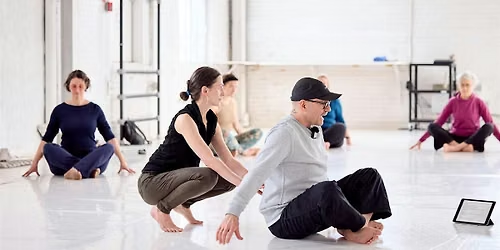
· Practical Lab: Learn external, hands-on assessments of diaphragm and pelvic floor function for appropriate clinical cases.
· Core Systems: Investigate the impact of developmental Diastasis Recti Abdominis (dDRA) on continence, movement efficiency, and balance, complete with treatment progressions.
Audience:
This course is designed for both experienced and newer clinicians who are new to pediatric pelvic health, providing foundational knowledge, assessment, and intervention skills appropriate for the pediatric setting.
Co-presented by Julie W. Wiebe, PT, DPT and Shelley Mannell, PT, BSc, BHSc
Day 1 objectives (26th Sept: Online)
- Discuss the prevalence of continence issues in 3 different paediatric populations.
- Reflect on the application of trauma informed care in how you speak, assess, intervene and gain consent from neurodiverse children and their families.
- Compare neurotypical and neurodivergent development of the anticipatory postural control system (aka “deep core”) inclusive of relationships between the diaphragm, transverse abdominis, pelvic floor, and intra-abdominal pressure systems.
- Develop breath mechanics strategies to link the anticipatory postural control and continence control systems as a foundation for three therapeutic activities.
- List 4 modifiable lifestyle factors that can have an impact on continence in both neurotypical and neurodivergent children.
- Develop 3 constipation intervention strategies for parents to help prevent nighttime accidents.
- Describe the interconnections between neurophysiologic, sensory processing, and emotional regulation systems as they relate to daytime and nighttime continence control.
- Gain intake and assessment tools that reveal a clinical profile that reflects the status of multiple systems that have a role in paediatric pelvic health concerns
Day 2 objectives ( Oct 23rd In-Person : Centre Saint-Pierre )
- Demonstrate a basic level of skill in assessment of components of the central control system – Diaphragm, Transversus Abdominis, and Pelvic Floor (including external palpation).
- Create a client profile from parent intake, assessment, and outcome measures to guide treatment planning.
- Identify functional and movement pattern differences that demonstrate central control and continence system challenges.
- Devise 2 external, movement based intervention strategies that simultaneously address neuromotor, sensory, and pelvic health needs.
- Demonstrate a basic level of skill in assessment of developmental Diastasis Recti Abdomins (dDRA).
- Develop 2 intervention strategies that manage dDRA for those with different neuromotor and/or sensory abilities.
- Create a plan of care that offers families pelvic health support alongside other treatment priorities.
Your Instructors
Shelley Mannell & Julie Wiebe
Shelley Mannell PT, BSc, BHSc is a knowledge seeker, problem solver and international speaker with a propensity to read scientific articles for clinical insight. Her mission is to bring relevant research into compassionate practice. As a Physiotherapist, Shelley helps children connect to their own bodies and raise their awareness of movement. She has been supporting children and families on their journey towards independence for over 35 years.Shelley’s enthusiasm for clinical research and education began at McMaster University as a clinical faculty member in the School of Rehabilitation Science. She has shared her knowledge and experience with clinicians around the world, focusing on the dynamic systems nature of postural control.Passionate about finding and developing approaches to enhance therapy, Shelley is certified in Neuro-developmental Treatment and Sensory Integration and is a children’s meditation facilitator. Shelley is also the co-creator of Dynamic Core for Kids, an approach to central stability for neurodiverse children that is used by therapists world-wide.
Join Shelley Mannell on social media: Facebook, Twitter,
PT, DPT Julie Wiebe, PT, DPT (she/her) has over 29 years of clinical experience in Sports Medicine and Pelvic Health, specializing in abdomio-pelvic, pregnancy, postpartum, and performance health for fit and athletic populations. She applies a systems-thinking model to optimize pelvic health integratively. Her external, movement-based strategies to support pelvic health alongside other treatment and fitness priorities have been successfully incorporated into a variety of populations by medical, rehab, and fitness professionals (ortho/sports, pelvic health, neurology, and pediatrics). Dr. Wiebe is a dedicated educator and sought-after speaker, delivering evidenced-based professional development lectures, curriculum, and coursework at clinics, academic institutions, residencies, and conferences internationally.
Follow it all and join the conversation with Julie on instagram, twitter and Facebook. Get your questions answered by Julie and find more content on You Tube.
Cancellation Policy
Important:
Any cancellation will incur a 10% administrative fee.
In addition, Eventbrite fees are non-refundable at all times.
If a cancellation occurs more than 30 days prior to the event, a full refund will be issued (minus the fees mentioned above).
After the 30-day period, no refunds will be accepted.
Parking ($) is available at the Centre Saint-Pierre, and microwaves will be at your disposal
Where is it happening?
Event Location & Nearby Stays:
CAD 460.74 to CAD 981.17