Nicola Suthor: The Intellectual Work of the Line in Early Modern Drawing

Advertisement
We take for granted the idea that the line’s movement possesses an innate imaginative capacity, without further asking how this became thinkable. Before the line could claim such interiority in its own right, it spent a significant period of time doing work that made such claims possible. The creative force ascribed to the line is the result of a long historical process during which the line gained mimetic power and announced its conceptual authority.
Renaissance art theory laid the groundwork for the empowerment of the line by ascribing to it an inherent intellectual capacity (in its demonstration of giudizio) and spiritual energy (in its expression of furore). Drawing became the principal medium for study through its ability to extract perceptual knowledge from the outside world and inscribe this knowledge into the memory of the artist, which was understood as a storehouse or reservoir from which a wealth of potential images could spring forth. Thus, early modern conceptions of drawing are defined not through outer form but by reference to two mentally demanding activities, memorizing and imagining, that should be thought of together. We will investigate how two types of line, one mimetic, the other operative, relate to and reify two types of memory function: explicit, semantic memory and implicit, procedural memory. How palpably the lines of memory traces and those of thought processes are interwoven will be explored in close-analyses that highlight formative moments within the history of European early modern drawing.
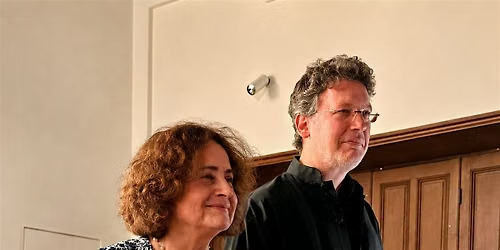
Nicola Suthor is professor of History of Art at Yale university. Before coming to Yale in 2015, she taught art history at the universities of Berlin (2012-14), Bern (2007-09), Hamburg (2011), Heidelberg (2009-11), and Stanford (2006). In 2011 she was visiting member of the Institute of Advanced Studies in Princeton. In 2012 she received the Jacob Burckhardt-Price of the Max Planck Institut in Florence. She was the Robert Lehman Visiting Professor (2017) and the Francesco De Dombrowski Visiting Professor (2020) at the Villa I Tatti, the Harvard University Center for Italian Renaissance Studies, Florence, Italy. In 2022, she was New-Horizon guest professor at the Department of Art History at the University of Tübingen, Germany.
Nicola Suthor has co-edited numerous volumes on different topics like Synergies in visual culture (Munich 2013), artistic rivalry and competition (Im Agon der Künste, Berlin 2007), aesthetic strategies of transfiguration (Verklärte Körper, Munich 2006), contagion as aesthetic principle (Ansteckung. Zur Körperlichkeit eines ästhetischen Prinzips, Munich 2005), the relation of art and scripture (Ars et scriptura, Berlin 2001) and the art of portraiture in art theory (Das Portrait, Berlin 1999). She has written three monographs on Titian (Augenlust bei Tizian, Munich 2004) Rembrandt (Rembrandt’s Roughness, Princeton Univ. Press 2018; German edition Munich 2015) and on Bravura: Virtuosity and Ambition in Early Modern Painting, Princeton Univ. Press 2020 (German edition Munich 2010).
Organized by Department Gerhard Wolf.
Photo: Albrecht Dürer, The Draughtsman of the Lute, woodcut, 13 x 18.2 cm
This will be a hybrid event.
VENUE
Palazzo Grifoni Budini Gattai
Via dei Servi 51
50122 Firenze, Italia
To participate online please register in advance via Zoom:
https://eu02web.zoom.us/meeting/register/Apf5bSs5SG-uzJ8XegbW3A#/registration
--
Kunsthistorisches Institut in Florenz – Max-Planck-Institut
Via Giuseppe Giusti 44
50121 Firenze, Italia
+39 055 24911-1
[email protected]
www.khi.fi.it
khi.fi.it/newsletter
instagram.com/khiflorenz
facebook.com/khiflorenz
bsky.app/khiflorenz.bsky.social
Renaissance art theory laid the groundwork for the empowerment of the line by ascribing to it an inherent intellectual capacity (in its demonstration of giudizio) and spiritual energy (in its expression of furore). Drawing became the principal medium for study through its ability to extract perceptual knowledge from the outside world and inscribe this knowledge into the memory of the artist, which was understood as a storehouse or reservoir from which a wealth of potential images could spring forth. Thus, early modern conceptions of drawing are defined not through outer form but by reference to two mentally demanding activities, memorizing and imagining, that should be thought of together. We will investigate how two types of line, one mimetic, the other operative, relate to and reify two types of memory function: explicit, semantic memory and implicit, procedural memory. How palpably the lines of memory traces and those of thought processes are interwoven will be explored in close-analyses that highlight formative moments within the history of European early modern drawing.
Nicola Suthor is professor of History of Art at Yale university. Before coming to Yale in 2015, she taught art history at the universities of Berlin (2012-14), Bern (2007-09), Hamburg (2011), Heidelberg (2009-11), and Stanford (2006). In 2011 she was visiting member of the Institute of Advanced Studies in Princeton. In 2012 she received the Jacob Burckhardt-Price of the Max Planck Institut in Florence. She was the Robert Lehman Visiting Professor (2017) and the Francesco De Dombrowski Visiting Professor (2020) at the Villa I Tatti, the Harvard University Center for Italian Renaissance Studies, Florence, Italy. In 2022, she was New-Horizon guest professor at the Department of Art History at the University of Tübingen, Germany.
Nicola Suthor has co-edited numerous volumes on different topics like Synergies in visual culture (Munich 2013), artistic rivalry and competition (Im Agon der Künste, Berlin 2007), aesthetic strategies of transfiguration (Verklärte Körper, Munich 2006), contagion as aesthetic principle (Ansteckung. Zur Körperlichkeit eines ästhetischen Prinzips, Munich 2005), the relation of art and scripture (Ars et scriptura, Berlin 2001) and the art of portraiture in art theory (Das Portrait, Berlin 1999). She has written three monographs on Titian (Augenlust bei Tizian, Munich 2004) Rembrandt (Rembrandt’s Roughness, Princeton Univ. Press 2018; German edition Munich 2015) and on Bravura: Virtuosity and Ambition in Early Modern Painting, Princeton Univ. Press 2020 (German edition Munich 2010).
Organized by Department Gerhard Wolf.
Photo: Albrecht Dürer, The Draughtsman of the Lute, woodcut, 13 x 18.2 cm
This will be a hybrid event.
VENUE
Palazzo Grifoni Budini Gattai
Via dei Servi 51
50122 Firenze, Italia
To participate online please register in advance via Zoom:
https://eu02web.zoom.us/meeting/register/Apf5bSs5SG-uzJ8XegbW3A#/registration
--
Kunsthistorisches Institut in Florenz – Max-Planck-Institut
Via Giuseppe Giusti 44
50121 Firenze, Italia
+39 055 24911-1
[email protected]
www.khi.fi.it
khi.fi.it/newsletter
instagram.com/khiflorenz
facebook.com/khiflorenz
bsky.app/khiflorenz.bsky.social
Advertisement
Where is it happening?
Palazzo Grifoni Budini Gattai, Via dei Servi, 51, 50122 Firenze FI, Italia, Firenze, Italy
Event Location & Nearby Stays:
Know what’s Happening Next — before everyone else does.
Host or PublisherKunsthistorisches Institut in Florenz