National Competition of Case Study On “Hara Bhara Swaraj - RISE & ACT”
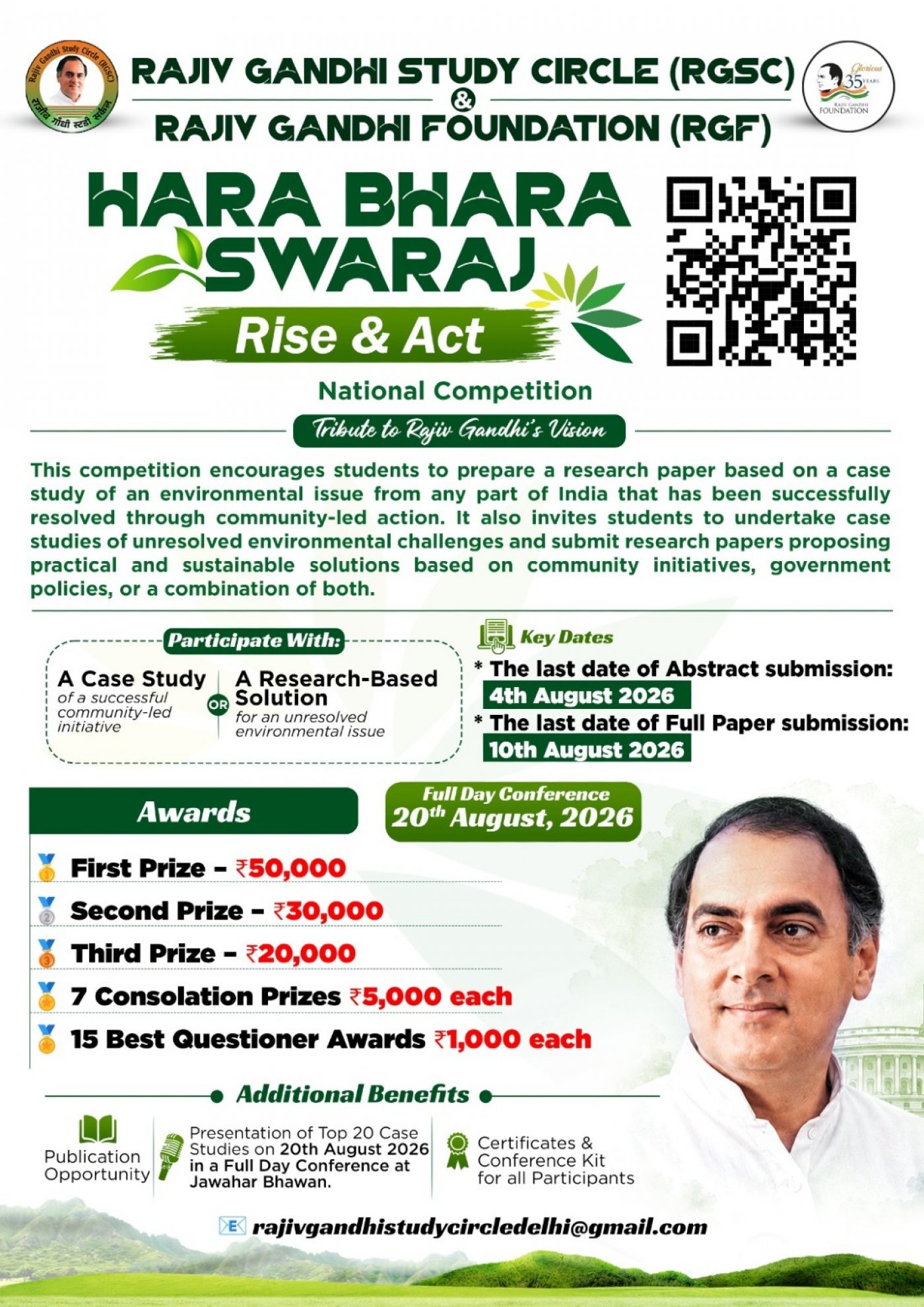
NATIONAL COMPETITION OF CASE STUDY
ON
"HARA BHARA SWARAJ – RISE & ACT"
Resilient Initiatives for Social, Environmental & Community Action
One-Day Conference on Thursday, 20th August 2026
Organized by
Rajiv Gandhi Study Circle and Rajiv Gandhi Foundation
To commemorate the 82nd birth anniversary of Shri Rajiv Gandhi
At
Jawahar Bhawan, Dr Rajendra Prasad Rd, Opposite Shastri Bhawan, Windsor Place, New Delhi, Delhi 110001
About Rajiv Gandhi Foundation
The Rajiv Gandhi Foundation (RGF) was set up on June 21, 1991, to realize the vision of Shri Rajiv Gandhi, former Prime Minister of India, who dreamt of a modern, secular, and progressive India that blends progress with rich cultural traditions, empowers women as equals, and uplifts the underprivileged.
From 1991 to 2009, the Foundation worked on health, literacy, science and technology, women's and children's development, disability support, Panchayati Raj institutions, natural resource management, and libraries. Since 2010, it has focused on education, while continuing flagship programmes including INTERACT (educational support to children impacted by conflict), the Rajiv Gandhi Access to Opportunities programme (mobility for physically challenged youth), the Rajiv Gandhi Cambridge Scholarship programme, Natural Resource Management (Gram Gaurav), Wonderoom, Antyoday Shiksha Abhiyan (AShA), Rajiv Ajeevika Samvardhan Abhiyan (RASA), Utilization of MGNREGA for Enhancing Agricultural Development (UMEAD), and Sadbhavana and Heritage, Outreach & Public Engagement (HOPE).
The Foundation is chaired by Smt. Sonia Gandhi. Other trustees include Shri P. Chidambaram, Shri Montek Singh Ahluwalia, Shri Suman Dubey, Shri Rahul Gandhi, Dr Ashok Ganguly, and Smt. Priyanka Gandhi Vadra.
About Rajiv Gandhi Study Circle
Rajiv Gandhi Study Circle (RGSC) is a national-level trust founded in 2005, chaired by Shri Ashok Gehlot. It brings together academicians and students and is dedicated to fostering upright, healthy, and progressive thinking through teacher-led academic engagement, dialogue, and mentorship, drawing inspiration from Rajiv Gandhi, Mahatma Gandhi, and Pt. Jawaharlal Nehru. RGSC promotes social justice, secularism, democratic citizenship, and respect for national leaders and social reformers, and has built a grassroots presence across states, districts, colleges, and universities as hubs for constructive, non-political civic engagement.
Introduction & Tribute
Social empowerment and environmental sustainability were central dimensions of Shri Rajiv Gandhi's vision for participatory development. As Prime Minister, he emphasised democratic decentralisation, technological modernisation, and community participation, and took concrete environmental steps such as setting up the National Wasteland Development Board in 1985 and strengthening the Environment Ministry.
Today India faces challenges including water scarcity, pollution, waste management, climate vulnerability, biodiversity loss, and unsustainable urban expansion. Yet across villages, towns, and cities, communities, youth groups, self-help groups, NGOs, and grassroots leaders are building meaningful responses through awareness campaigns, conservation initiatives, sustainable practices, and participatory governance.
This competition is a tribute to Rajiv Gandhi's vision of inclusive and sustainable development. It encourages students and young researchers to document community-led environmental initiatives and propose practical solutions to unresolved local challenges.
Objectives
- To honour Shri Rajiv Gandhi's vision of sustainable and inclusive development
- To encourage practical action and documentation of local social and environmental issues
- To highlight the role of community participation in solving local challenges
- To promote youth engagement with sustainability and civic action
- To create awareness about successful grassroots environmental initiatives
- To develop a repository of community-driven models and innovative local solutions
Eligibility
Open to all undergraduate, postgraduate, and PhD students across universities and colleges in India.
Format
Individual or Team (up to 2 members). Participants may submit:
- A case study of a local environmental or social issue successfully addressed through community efforts, OR
- A research and participatory consultation-based proposed solution for a local issue that still requires intervention
Theme
This competition encourages students to prepare a research paper based on a case study of an environmental issue from any part of India that has been successfully resolved through community-led action. Alternatively, students can conduct case studies of unresolved environmental challenges and submit research papers proposing solutions grounded in community-led initiatives, government policies, or a combination of both.
Sub-Themes
- - Water conservation and management
- - Waste management and recycling
- - River, lake, or pond restoration
- - Community afforestation initiatives
- - Pollution mitigation
- - Climate change adaptation
- - Sustainable agriculture
- - Plastic-free campaigns
- - Community health and sanitation initiatives
- - Local governance and public participation
- - Youth-led environmental movements
- - Renewable energy at community level
- - Deforestation
- - The gender-climate-environment nexus
Suggested Case Study Structure
1. Introduction: Nature of the issue and geographical context
2. Background: History and local impact of the problem
3. Community Engagement: Role of citizens, organisations, local bodies, or the government
4. Solution/Intervention: Steps taken or proposed
5. Impact: Social, environmental, or economic outcomes
6. Challenges and Limitations
7. Lessons and Recommendations
Original, high-quality empirical case study research papers/working papers are invited from scholars, researchers, and students. Sub-themes are indicative; papers on other related areas may also be submitted. Full case study research works should be submitted via email to [email protected]. Authors of selected papers will be given an opportunity to present their papers during the sessions on the day of the one-day conference.
Key Dates
- Last date for Abstract submission: 4th August 2026
- Last date for Full Paper submission: 10th August 2026
- Date of One-Day Conference: Thursday, 20th August 2026
Registration Link: Registration Form
(No Registration Fee)
Submission Guidelines:-
- - Participants must submit a Word document of 4,000-5,000 words prepared in APA 7th Edition style, along with a Plagiarism Report (less than 12%) and an AI Usage Report (less than 30%), in English or Hindi
- - Format: Times New Roman, 12pt, 1.5 spacing
- - Must include photographs, interviews, media references, or field observations
- - Individual or joint submissions (maximum two participants)
- Add Declaration document e.g. "I certify that this research work is original, free from plagiarism, that all sources have been properly acknowledged, and that there is no conflict of interest related to this work."
Judging Criteria
- - Originality and relevance of the issue (20%)
- - Depth of participation and research (20%)
- - Practicality and sustainability of the solution (20%)
- - Community participation and impact (20%)
- - Clarity of analysis and presentation (20%)
Judges: Prof Yasheshwer, Dr Sonu Kumar Gupta
Awards & Recognition
- 1st Prize: ₹50,000
- 2nd Prize: ₹30,000
- 3rd Prize: ₹20,000
- 7 Consolation Prizes: ₹5,000 each
- 15 Best Questioners (from the audience): ₹1,000 each, during the award ceremony
- Certificates of Participation and Conference Kit for all eligible participants
- Top 20 case studies will get a chance to present at the award ceremony in August 2026; the Top 10 will be selected from them
Future Plans with the Case Studies
The selected case studies will contribute toward:
- - Publication: A special publication featuring selected case studies and proposed solutions
- - Community Outreach: Connecting students with NGOs, local communities, and environmental practitioners
- - Policy Dialogue: Sharing selected findings with civil society organisations, local bodies, and policymakers to encourage implementation and public awareness
Suggested Event Tagline: "Local Voices, Collective Action, Sustainable Futures"
Special Segment (during the award ceremony)
- - Panel discussion on environmental sustainability and community action
- - Exhibition of grassroots environmental initiatives from across India
- - Documentary screening on local environmental movements
- - Student interaction with activists, researchers, and policymakers
Chief Patron: Rajiv Gandhi Foundation; Shri Ashok Gehlot, Chairman, RGSC
Patrons: Professor Satish Kumar, National Coordinator, RGSC; Dr Chayanika Uniyal, National Co-Coordinator, RGSC
Programme Directors:
- - Dr. S.M. Mahmood, Delhi RGSC State Co-Coordinator, Retired Associate Professor, Dept of Engineering, Jamia Millia Islamia University — M. 9868856174
- - Mr Saurabh Kumar Rai, National Student Secretary, RGSC — Mobile +91 99588 38655, Email: [email protected]
Academic Directors:
- - Prof Yasheshwar, Delhi University South Campus RGSC Coordinator, ANDC University of Delhi — Mobile +91 98101 33500, Email: [email protected]
- - Dr Firdous Azmat Siddiqui, RGSC University Coordinator for Jamia Millia Islamia, Sarojini Naidu Centre for Women's Studies — M +91 98107 20568, Email: [email protected]
Organizing Secretaries:
- - Dr Kali Chittibabu, RGSC University Coordinator for JNU, Assistant Professor, Centre for Informal Sector & Labour Studies — Email: [email protected] / [email protected]
- - Prof. Jnanendra Singh, Coordinator, RGSC Delhi University, Librarian, Dayal Singh College Eve. — [email protected], 9810382676
- - Ms. Shaijal Gupta, State Student Secretary, Delhi
- - Mr Yaseen Batt, State Student Secretary, Himachal
For queries, please contact:
1. Shaijal Gupta, Student Secretary, Delhi — +91 95540 19993
2. Alam, Student Secretary,
Law Centre 2, FACULTY OF LAW,
UNIVERSITY OF DELHI— +91 91428 72894
3. Mamnun Ahmed, Student Secretary, JMI
4. Rani Singh, Student Secretary, JMI — +91 8076 622 418
Join WhatsApp group for further information: https://chat.whatsapp.com/LrEfB4rDSI98DJYIvBHTZ7
Where is it happening?
Event Location & Nearby Stays: