Long Exposure: Recent Work by Alumni of College of DAAP Fine Art Photography Program

Advertisement
Open to the Public: September 13th - November 25th, 2026
Artist Reception: Thursday, October 22nd, 5-7pm
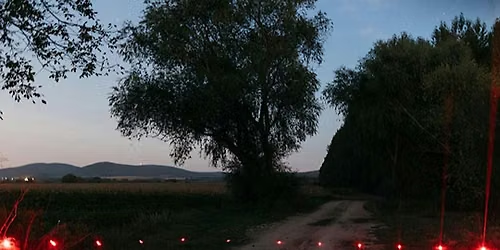
Long Exposure surveys the breadth and vitality of contemporary lens-based practice by alumni of the University of Cincinnati's College of Design, Architecture, Art, and Planning. On view in Reed Gallery, the exhibition draws from work created since the year 2000, tracing the range of approaches, concerns, and aesthetics that graduates carry into the broader field. Curated by Jane Alden Stevens, Jordan Tate, John-David Richardson, and Kate Bonansinga, the exhibition highlights the continued relevance of a program grounded in critical inquiry and expanded photographic practice.
Participating artists: Anjali Alm-Basu, Gabrielle Barrera, Emmaline Carter, Tyler Chumney, Annie Concannon, Lauren Darpel, Addie Eichbauer, Laura Fisher, Peiter Griga, Mallory Henman, Robert Hein, Justin Hodges, Ellis Johnson, Luke Kindle, Sarah Knobel, Grant Lawler, Jesse Ly, Alex Macon, Wyatt Niehaus, Frankie Park, Rachel Rampleman, Danielle Schuster, Vidushi Shrivastava, Sheida Soleimani, Fazilat Soukhakian, Aubrey Theobald, Ivo Vretenarov, and Casey James Wilson
Curators: Jane Alden Stevens, Jordan Tate, John-David Richardson, and Kate Bonansinga
Support for this 2026 FotoFocus Biennial exhibition was provided by FotoFocus
Long Exposure is part of the 2026 Fotofocus Biennial: The Long View
The Long View
Biennial Opening Events: September 30–October 3, 2026
"The long view” is a phrase used to invoke a broader perspective. It suggests both distance and duration, i.e., looking far into the distance and looking for a long period of time. As an attitude toward history, the long view suggests a wise and measured perspective, one that takes into consideration both the distant past while also considering the distant future. The long view also describes in literal terms two primary functions of photography; photographic lenses both enable long-distance vision and long-duration viewing. The 2026 Biennial theme, The Long View, considers photography as a metaphor for our attempt to grasp our place within the durational sweep of history.
Investors take the long view to speculate about the future, to predict outcomes from actions made in the present day. In certain Indigenous cultures, the long view is expressed by the principle of Seven Generations, which instructs one to consider not only the present but also the future, to consider how decisions today will affect those seven generations from now. Another version places humans at the center of the seven generations, recognizing the three generations that came before and the three that will come after.
The Long View acknowledges the semiquincentennial of the United States, encouraging a posture of reflection in regards to the grand sweep of our country’s history, its past, present, and future. Photography can show us many moments from that history but it can also serve as a metaphor for how we understand our history and decide to shape it over time.
To elaborate, the theme considers aspects of time and perspective in photography and film, and how these mediums shape our understanding of the world. Time and perspective are fundamental aspects of photography. Time operates most essentially in terms of the duration of the photographic exposure. Early photographic technologies in particular were notoriously slow, requiring animated subjects to remain still for long periods of time, while faster films of the early-twentieth century allowed for instantaneous exposures, or snapshots. No matter the duration of the exposure, photographs, of course, once made, may be regarded for any length of time, for a split second, as for an Instagram post, or protractedly, for a photograph of an absent loved one.
Perspective is also an essential aspect of photography. The camera’s position in relation to subject matter remains essential in terms of the composition and, ultimately, the final impact of a photograph. Close up for greater detail, far away for greater context—these are also critical decisions in relation to photographic meaning. Furthermore, distance can be paradoxical: a telephoto view of the night sky, something far away but seen up close, will render stars and other bodies in greater isolation and detail, while an image of microorganisms can open entire biological landscapes not seen before.
Advertisement
Where is it happening?
Room 5275, 2624 Clifton Ct., DAAP Building, Cincinnati, OH, 45221, United States
Event Location & Nearby Stays:
Know what’s Happening Next — before everyone else does.
Host or PublisherDAAP Galleries