International Conference on Indentured Labor

About this Event
International Conference on Indentured Labor
In 2023 it was 160 years ago that the first indentured laborers from Asian countries came to Suriname to work on the fields as substitutes of the slaves who were granted freedom when the transatlantic slavery was abolishedin the Dutch West-Indies in 1863. The term "indentured labor" in this context proves misleading, as both slavery and indentured labor were accompanied by coercion, repression, and structural inequality. Therefore, indentured labor cannot be viewed in isolation from the history of slavery but must be understood as a continuation of it within the colonial system.
This requires a sound knowledge of this past. The Collectief Contractarbeid aims to bring this to the fore, with the cooperation of the Anton de Kom Chair at the Vrije Universiteit Amsterdam. The aim of the forthcoming conference is twofold: to have an inventoryof the academical research done on indentured labor and to build a global network of scientists and scholars active in this field. We hope that this will also bring about insights into gaps in the research. Academic networks are requested to identify nationaland international experts in this field who will be invited to have a role in the conference.This will be of significant benefit to communities of descendants of indentured laborers around the world!The audience will consist of scholars and experts, supplemented by stakeholders from the communities affiliated with indentured labor. The conference is seen as a first, important step in bridging the gap between indentured labor, the history of slavery, andthe broader colonial system, with the aim of stimulating further research.
Practical information
- The conference will be organized in a hybrid format (in person and online), allowing internationals to participate.
- The conference language will be English.
- The target attendance in person is approximately 120–150 people.
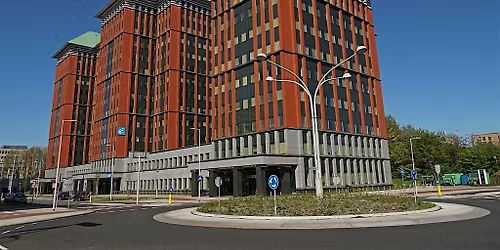
- Date: June 20, 2026 13:30 – 17:30 CET (Dutch time), at the Vrije Universiteit, Boelelaan1105, 1081 HV Amsterdam, room HG 14A00
- Mail contact: [email protected]
Agenda
🕑: 01:30 PM - 02:00 PM
Keynote: Guno Jones
Host: Prof. Dr. Guno Jones
Info: From the Anton de Kom Chair, Professor Guno Jones will reflect on why a broad perspective on the study of colonialism and its afterlives—one that encompasses both slavery and indentured labour—is important for our understanding of the past and the present.
🕑: 02:15 PM - 03:15 PM
Round `1: Workshop "Women in forced labor"
Host: Rita Tjien Fooh
Info: Relatively little is known about slavery and contract labor from a female perspective, something that was hardly, if at all, documented in the past. In this workshop, Tanya Sitaram and Rita Tjien Fooh focus on the female perspective of contract labor. Tanya Sitaram's master's thesis specifically addresses the role and position of the Hindustani female contract laborer. Although her doctoral research has a broader angle (the role of emotion in migrant letters), she will share her insights regarding women within the system of contract labor in the workshop. Rita Tjien Fooh, archivist and historian, has published on the colonial perception of Javanese women. And can these insights also be linked to experiences from slavery?
🕑: 02:15 PM - 03:15 PM
Round 1: Workshop "Towards a Shared Surinamese Identity"
Host: Prof. Dr. Rosemarijn Hoëfte
Info: During slavery and the period of indentured labor, slaves and laborers with diverse backgrounds were shipped to Suriname. These cheap, unfree laborers formed a society in Suriname organized along ethnic lines. Nevertheless, people slowly moved towards a Surinamese identity. In her workshop, Prof. Rosemarijn Hoëfte will discuss the manifestations she has investigated that seem to point to this convergence towards a shared Surinamese identity. David Dabydeen, Professor Emeritus at the University of Warwick, will join digitally to speak about a new project concerning the shared history of Guyana.
🕑: 02:15 PM - 03:15 PM
Round 1: Workshop "Faith, Resilience, and Intergenerational Strength"
Host: Dr. Kirtie Algoe
Info: Slavery and indentured labor leave deep scars. People cut off from their communities and families suffer for at least four generations from discontinuity, fragmentation, and a lack of cohesion. Dr. Kirtie Algoe investigates how Indo-Surinamese indentured laborers in the Caribbean practiced their religion amidst their harsh existence. In what ways have religious sources of strength from slavery and indentured labor been passed down to younger generations over time, and how do they help different groups live together? As a transcultural systems therapist, Kitlyn Tjin A Djie has expertise in guiding clients with a migration background. Her focus is on finding sources of strength embedded in one's own culture and family.
🕑: 02:30 PM - 03:30 PM
Round 1: Workshop "Postcolonial Heritage in the Netherlands"
Host: Dr. Jaswina Elahi
Info: The music, dance, food, ritual and craft of postcolonial communities in the Netherlands constitute a living heritage that remains largely invisible within the official heritage field. This workshop explores what that heritage is, what distinguishes it from other forms of heritage, how it has developed through decades of displacement and adaptation, and what its future requires. Drawing on her research, Dr. Jaswina Elahi traces the characteristics that set postcolonial heritage apart, and the tension between sound and silence that runs through all of them: heritage that lives in voices, rhythms and gestures, but is kept invisible by a double silence: institutions that do not ask, and communities whose earlier generations did not speak. At its core, this is a story about power; about who is recognized as a maker of culture and whose heritage counts.
🕑: 03:30 PM - 04:30 PM
Round 2: Workshop "Transnational Communities and Younger Generations"
Host: C. Choenni
Info: Due to colonialism, members of families and parts of communities ended up in different countries. However, historical ties have remained. This has led to the emergence of now vibrant transnational communities. What can these transnational communities mean for the issues and needs of the younger generations from these communities in the Netherlands? Prof. Dr. C. Choenni has studied the transmission strategies of Hindustani indentured laborers in various countries.
🕑: 03:30 PM - 04:30 PM
Round 2: Workshop "Indentured Labor and Slavery: Similarities and Differences"
Host: Prof. Wickramasinghe
Info: Descendants of indentured laborers show a greater interest in the history of their ancestors today than they did a few generations ago. Perhaps the increased attention to the history of slavery has reinforced this process. On the other hand, serious questions are being raised regarding the link between indentured labor and slavery, because in many cases, indentured labor is viewed as a less cruel and more humane successor to original slavery. This does not do justice to the unique character of indentured labor. Prof. Wickramasinghe of Leiden University analyzes the similarities and differences between slavery and indentured labor.
🕑: 03:30 PM - 04:30 PM
Round 2: Workshop: "Preserving Culture Across Communities"
Host: Carla Tjon
Info: The three communities (Chinese, Javanese, and Hindostani) in Suriname have made efforts to preserve their own culture and ties to their country of origin. However, they did so in three fairly different ways. Why, and with what result? For instance, the Chinese took very extreme measures in some cases. The eldest son was sent back to China to receive a Chinese upbringing and to preserve Chinese culture for the family line. Cultural historian Carla Tjon paints a picture of the Chinese community, and Prakash Kumar Jha, Founder & Director of the Pravasi Setu Foundation, provides an overview of the Hindostani community.
🕑: 03:30 PM - 04:30 PM
Round 2: Workshop " New dynamics in the communities"
Host: Ference Wongokario-Nojotaroeno
Info: In the Netherlands, the descendants of the enslaved and indentured laborers are once again encountering diaspora, such as knowledge workers from India or China. There also exists a vibrant community of people descended directly from Indonesia. How does this development affect the need for a sense of identity among the descendants of indentured laborers and the enslaved? Ference Wongsokario-Nojotaroeno, chair of the Gema Rasa foundation, is committed to keeping culture, language, heritage and performing arts alive. She builds bridges between the Netherlands, Suriname and Indonesia, and actively seeks connection with these communities. As chair of the Dutch branch of the global network of Diaspora Indo-Dutch, Prakash Jankipersad is equally committed to bringing both communities together.
🕑: 04:15 PM - 05:00 PM
Feedback & Discussion
🕑: 05:00 PM - 05:30 PM
Reception
Where is it happening?
Event Location & Nearby Stays:
EUR 0.00