Black Violin - Be Free Tour 26 at The Kent Stage Nov 8th

Advertisement
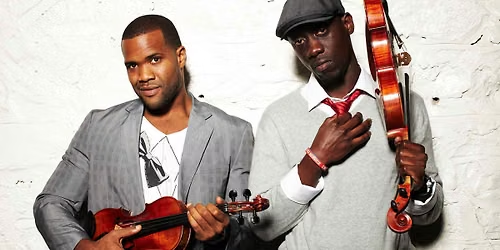
Black Violin has always been about taking things further, exceeding expectations, challenging conventions. The duo has steadily built a devoted following and a diverse touring base— culminating in such triumphs as two sold-out shows at the Kennedy Center with the National Symphony Orchestra commemorating the 50th anniversary of Dr. Martin Luther King Jr.’s death, and appearances on the Today Show, CBS Mornings, and PBS Newshour—while occupying a musical lane that’s entirely its own.
Black Violin’s work extends far beyond the stage, reaching deep into communities nationwide with numerous free performances for students and hands-on engagement with youth symphonies and community centers. Through collaborations with local and national education programs such as Turnaround Arts, Baptiste and Marcus connect with more than 100,000 students throughout the year, including low-income and Title 1 schools, and adopted Bethune Elementary, in Florida’s Broward County (near where they grew up) to initiate an ongoing mentorship program.
The members of Black Violin met on the first day of orchestra class in 1996 at Dillard High School of the Performing Arts in Fort Lauderdale. (Baptiste originally wanted to play saxophone in the band, but the orchestra teacher got him assigned to his class after winning a golf bet with the band instructor.) Classically trained by day, they faithfully put on their headphones and listened to the hottest rap records each night. They went to different colleges—Marcus attended Florida International University and Baptiste went to Florida State—but then reconvened, moved into an apartment together, and started trying to produce other musicians.
They developed an act covering hip-hop songs on their violins, which became popular in local clubs. Two years after sending in a tape to Showtime at the Apollo, they were invited to appear on the show—which they won, and kept winning.
They were approached by the manager of Alicia Keys, who asked them to perform with the singer at the Billboard Awards. Other offers followed—they toured with Mike Shinoda of Linkin Park, opened for the Wu-Tang Clan, and worked with the likes of Alessia Cara, 2 Chainz, and Lil Wayne. All the while, Black Violin continued touring non-stop (playing as many as 200 shows a year) and released two independent, self-financed albums before putting out the acclaimed Stereotypes in 2016, followed by 2019’s Take the Stairs.
“Wil and I are similar, but we approach music in different ways,” notes Marcus. “He says that he searches for music that feels good but oftentimes, music that feels good isn’t music that necessarily transcends anything. With Black Violin, I look for music that challenges people—for me, number one, it has to be like, what the f**k is this? If you get that reaction the first time you feel it, you’ll never forget us. And that, to me, has been the whole thing. It has to be disruptive; it has to be chaotic beauty. What can I do that no one else thought was possible? That’s the driving force for me as a creator.”
Black Violin’s work extends far beyond the stage, reaching deep into communities nationwide with numerous free performances for students and hands-on engagement with youth symphonies and community centers. Through collaborations with local and national education programs such as Turnaround Arts, Baptiste and Marcus connect with more than 100,000 students throughout the year, including low-income and Title 1 schools, and adopted Bethune Elementary, in Florida’s Broward County (near where they grew up) to initiate an ongoing mentorship program.
The members of Black Violin met on the first day of orchestra class in 1996 at Dillard High School of the Performing Arts in Fort Lauderdale. (Baptiste originally wanted to play saxophone in the band, but the orchestra teacher got him assigned to his class after winning a golf bet with the band instructor.) Classically trained by day, they faithfully put on their headphones and listened to the hottest rap records each night. They went to different colleges—Marcus attended Florida International University and Baptiste went to Florida State—but then reconvened, moved into an apartment together, and started trying to produce other musicians.
They developed an act covering hip-hop songs on their violins, which became popular in local clubs. Two years after sending in a tape to Showtime at the Apollo, they were invited to appear on the show—which they won, and kept winning.
They were approached by the manager of Alicia Keys, who asked them to perform with the singer at the Billboard Awards. Other offers followed—they toured with Mike Shinoda of Linkin Park, opened for the Wu-Tang Clan, and worked with the likes of Alessia Cara, 2 Chainz, and Lil Wayne. All the while, Black Violin continued touring non-stop (playing as many as 200 shows a year) and released two independent, self-financed albums before putting out the acclaimed Stereotypes in 2016, followed by 2019’s Take the Stairs.
“Wil and I are similar, but we approach music in different ways,” notes Marcus. “He says that he searches for music that feels good but oftentimes, music that feels good isn’t music that necessarily transcends anything. With Black Violin, I look for music that challenges people—for me, number one, it has to be like, what the f**k is this? If you get that reaction the first time you feel it, you’ll never forget us. And that, to me, has been the whole thing. It has to be disruptive; it has to be chaotic beauty. What can I do that no one else thought was possible? That’s the driving force for me as a creator.”
Advertisement
Where is it happening?
175 E. Main St., Kent, OH, United States, Ohio 44240
Event Location & Nearby Stays:
Know what’s Happening Next — before everyone else does.
Host or PublisherThe Kent Stage