AUPRF Remediation, Reclamation & Ecological Forum

About this Event
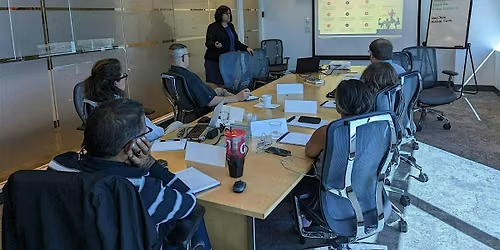
Hosted by PTAC Petroleum Technology Alliance Canada on June 25, 2026, in Calgary at the U of C Downtown Campus in DTC 241 (in person), this AUPRF forum will bring together members of the Remediation & Reclamation Research Committee (RRRC) and the Ecological Research Planning Committee (ERPC), along with researchers and stakeholders, to showcase high-value completed and ongoing research.
The forum is designed around clear, time-boxed project presentations with Q&A and dedicated discussion blocks to emphasize practical applications, decision-support value, and implementation pathways—with a joint session to identify cross-committee coordination opportunities (shared methods, shared datasets, aligned pilots, coordinated communications) and capture concrete action items for next steps.
The AUPRF Remediation, Reclamation & Ecological Forum will showcase work on remote sensing and soil remediation for salts, metals, and hydrocarbons, and identify solutions to pressing environmental management challenges in the oil and gas sector.
Agenda
🕑: 08:00 AM - 08:45 AM
Breakfast & Networking
🕑: 08:45 AM - 09:00 AM
Welcome & Objectives
🕑: 09:00 AM - 09:25 AM
Standardized Approach to Risk Assessment
Host: Douglas Haney, Worley Canada Services Ltd.
Info: 24-RRRC-03: Mass-based risk assessment approaches can supplement numerical endpoints in contaminated site management. This presentation evaluates total mass, mass flux, mass partitioning, mass transfer, mass loading, and mass balance, and demonstrates how these approaches can improve regulatory decision-making, reduce remediation costs, and support sustainable site management.
🕑: 09:25 AM - 09:50 AM
Chloride and Salinity Management in Remediation, Reclamation, and Closure
Host: Greg Huber, Equilibrium Environmental Inc.
Info: 25-RRRC-04: This collaborative project focuses on advancing understanding of chloride and salinity management approaches for remediation, reclamation, and closure in Alberta. This presentation summarizes early-stage work examining practical data gaps and regulatory uncertainties affecting delineation, ecological risk assessment, long-term management, and efficient outcomes for salt-impacted sites.
🕑: 09:50 AM - 10:05 AM
Morning Coffee Break & Networking
🕑: 10:05 AM - 10:30 AM
Development of EcoContact Soil Selenium Guideline
Host: Viktoria Winter, Equilibrium Environmental Inc.
Info: 24-RRRC-01: This presentation summarizes recent PTAC-funded research supporting development of EcoContact soil selenium guidelines for Alberta. Multi-species toxicity testing demonstrated that sulphate can significantly reduce selenium toxicity and plant uptake in coarse and fine soils. Results highlight dose-dependent selenium-sulphate interactions, implications for guideline development, and future bioaccumulation research needs.
🕑: 10:30 AM - 10:55 AM
Remote Sensing for Reclamation and Wildlife Monitoring
Host: Eduardo Loos, Vertex Resource Group Ltd.
Info: 25-RRRC-05: This project will evaluate and validate various remote sensing (RS) and Earth Observation (EO) technologies for reclamation certification and equivalent land capability (ELC) assessments in Alberta and Western Canada with a focus on forested and cultivated lands. It will also include a dedicated component on the use of drones and RS/EO for wildlife monitoring.
🕑: 10:55 AM - 11:20 AM
Remote Sensing to Manage Incidental Take Risk of Pileated Woodpeckers
Host: Erin Bayne, University of Alberta
Info: 24-ERPC-01: Will discuss how acoustic recording units, wildlife cameras, and remote sensing using satellites and LiDAR can be combined to address key wildlife management challenges in Alberta. Case studies that demonstrate the efficacy of reducing incidental take of Pileated Woodpecker cavities, evaluating habitat recovery at well sites and linear features for birds and small mammals, and tracking edge effects from mines on species of concern like the Yellow Rail will be emphasized.
🕑: 11:20 AM - 12:05 PM
RRRC & ERPC Overlap & Coordination Themes
🕑: 12:05 PM - 12:50 PM
Lunch & Networking
🕑: 12:50 PM - 01:15 PM
Conventional vs. Passive Management of Noxious Weeds
Host: Amanda Schoonmaker, NAIT
Info: 23-RRRC-04 & 25-RRRC-01: In Alberta, herbicides (and hand-pulling to some extent) are the conventional methods for controlling or eliminating noxious weeds on reclaimed industrial sites. However, this approach may be counterproductive to re-establishing forest vegetation, as overspray on non-target native forest vegetation may impede the recovery of desirable species. This project aims to test the effectiveness of conventional W**d management as a long-term control of weeds in recently reclaimed industrial sites in Alberta. In this presentation we will discuss the historical context and framework of this project and provide preliminary results relating to observations during the 2025 field season.
🕑: 01:15 PM - 01:40 PM
Evaluation of Chloride Soil & Groundwater Partitioning
Host: Ashley Morgan, Onterris
Info: 24-RRRC-04: Risk evaluations for chloride‑impacted sites often focus on groundwater concentrations despite typically having more extensive soil data. We examine the value of integrating soil and groundwater datasets, along with associated challenges and uncertainties, and discuss how proper integration improves resolution of chloride plumes.
🕑: 01:40 PM - 02:05 PM
Technology-based Assessments for Use in Reclamation Certification
Host: Stefan Schreiber, InnoTech Alberta
Info: 24-RRRC-05: Under Alberta’s regulatory framework, reclamation certificates require restored oil and gas wellsites achieve equivalent land capability without further intervention. Field assessments are costly, prompting evaluation of LiDAR and multispectral remote sensing. Results show supporting value for structure, density, and triage, but limited species discrimination prevents full replacement currently under regulations.
🕑: 02:05 PM - 02:15 PM
Coffee Break & Networking
🕑: 02:15 PM - 02:40 PM
Effects of Oil and Gas on Reproductive Rates of Prey Species in Caribou Ranges
Host: Laura Finnegan, fRI Research
Info: 24-ERPC-04: Across Canada, woodland caribou are declining partly because habitat disturbance creates early-seral vegetation, altering predator–prey dynamics. In Alberta, camera data showed forage and surrounding landscape influenced ungulate occurrence in disturbances and differed by reproductive status. Managing forage species and landscape-scale restoration could address these effects and support caribou recovery.
🕑: 02:40 PM - 03:05 PM
Using Environmental Genomics for Regulatory Needs
Host: Brian Eaton, InnoTech Alberta
Info: 25-ERPC-06: Environmental monitoring using genomics can reduce time, cost, and impact on species and habitat, but has not been widely adopted for regulatory monitoring in Alberta. The goal of this project is to explore the most efficient pathway to integrating genomic methods as a tool for regulatory monitoring in an Alberta context.
🕑: 03:05 PM - 03:30 PM
10-Year Benefits and Outcomes of Algar Caribou Habitat Restoration
Host: Scott Wilson, Silvacom
Info: 25-ERPC-04: Just over 10 years ago, six oil sands producers completed restoration of legacy seismic lines to support caribou habitat recovery in Algar. Silvacom recently assessed restoration outcomes while evaluating remote sensing monitoring protocols. Scott explains how these findings can be applied to support sub-regional plan restoration requirements in Alberta.
🕑: 03:30 PM - 04:15 PM
Plenary RRRC & ERPC Overlap and Coordination Themes: Action Items & Next Steps
🕑: 04:15 PM - 05:00 PM
Adjournment & Networking
Where is it happening?
Event Location & Nearby Stays:
CAD 106.95 to CAD 162.55