Asynchronous Histories Summer School. Second Edition

Advertisement
The Asynchronous Histories Summer School aims to explore regions and moments in history marked by the coexistence of asynchronous sociopolitical tendencies and processes. These conditions often reveal paradoxical outcomes when seemingly well-established actors and mechanisms are put into practice. The absence—or inefficiency—of "The Great Synchronizer," whether imperial order, centralized state apparatus, or the power of capital, has, in various periods and regions, created fertile grounds for blending the old and the new in unequal and unexpected ways.
Rather than viewing this coexistence of asynchronicities as a static phenomenon, we understand it as a dynamic and intricate process. In such situations, old forms may act as tools paving the way for new developments, while new forms may consolidate old arrangements, laws, and privileges. This interplay also triggers epistemological challenges, as research tools developed in global centres often fail to yield productive results when applied to these complex settings. This is why it is both challenging and indispensable to abandon normative definitions of phenomena and states of affairs in favour of listening to local actors, whose diversity ultimately calls into question apparently universal models and descriptions of reality—models that, in practice, are deeply rooted in Western centres.
In adopting such a perspective, we draw inspiration from several contemporary intellectual currents that seek to develop thinking in this direction. First, Reinhart Koselleck’s concept of multiple temporalities enables us to discern the non-linear character of time in human societies. Second, postcolonial and subaltern narratives continually challenge Western epistemic frameworks that remain incongruent with large parts of the world beyond capitalist centers. Third, alternative conceptions of modernity pave the way for rethinking the modern project as a plural rather than a singular phenomenon.
By understanding asynchronicity in such ways, we aim to encourage a rethinking of the past through this powerful umbrella tool. We invite early-career scholars from all areas of the humanities and social sciences to join us in a shared intellectual exploration.
Exemplary areas of inquiry include:
1. Western ideologies in non-Western settings.
2. Mixed temporalities and their synchronization.
3. Non-linear conceptions of progress.
4. Alt-modernities.
5. Two economic systems in one setting.
6. Transfers as resistance; transfers as domination.
7. Unrealized potentials, repressed imaginaries, and projects halted midway.
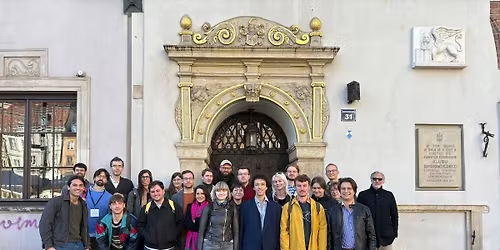
Report (in Polish) and photos from the first edition:
https://wsnsir.uw.edu.pl/asynchronous-histories-summer-school/
Organizing Institutions
Institute of Applied Social Sciences, University of Warsaw
The German Historical Institute, Warsaw
The Gabriel Narutowicz Institute of Political Thought
in partnership with
Tadeusz Manteuffel Institute of History of the Polish Academy of Sciences
The History of Concepts Group
Rather than viewing this coexistence of asynchronicities as a static phenomenon, we understand it as a dynamic and intricate process. In such situations, old forms may act as tools paving the way for new developments, while new forms may consolidate old arrangements, laws, and privileges. This interplay also triggers epistemological challenges, as research tools developed in global centres often fail to yield productive results when applied to these complex settings. This is why it is both challenging and indispensable to abandon normative definitions of phenomena and states of affairs in favour of listening to local actors, whose diversity ultimately calls into question apparently universal models and descriptions of reality—models that, in practice, are deeply rooted in Western centres.
In adopting such a perspective, we draw inspiration from several contemporary intellectual currents that seek to develop thinking in this direction. First, Reinhart Koselleck’s concept of multiple temporalities enables us to discern the non-linear character of time in human societies. Second, postcolonial and subaltern narratives continually challenge Western epistemic frameworks that remain incongruent with large parts of the world beyond capitalist centers. Third, alternative conceptions of modernity pave the way for rethinking the modern project as a plural rather than a singular phenomenon.
By understanding asynchronicity in such ways, we aim to encourage a rethinking of the past through this powerful umbrella tool. We invite early-career scholars from all areas of the humanities and social sciences to join us in a shared intellectual exploration.
Exemplary areas of inquiry include:
1. Western ideologies in non-Western settings.
2. Mixed temporalities and their synchronization.
3. Non-linear conceptions of progress.
4. Alt-modernities.
5. Two economic systems in one setting.
6. Transfers as resistance; transfers as domination.
7. Unrealized potentials, repressed imaginaries, and projects halted midway.
Report (in Polish) and photos from the first edition:
https://wsnsir.uw.edu.pl/asynchronous-histories-summer-school/
Organizing Institutions
Institute of Applied Social Sciences, University of Warsaw
The German Historical Institute, Warsaw
The Gabriel Narutowicz Institute of Political Thought
in partnership with
Tadeusz Manteuffel Institute of History of the Polish Academy of Sciences
The History of Concepts Group
Advertisement
Where is it happening?
Warszawa, Pamiątki pl. Defilad, 00-110 Śródmieście, Polska, Warsaw, Poland
Event Location & Nearby Stays:
Know what’s Happening Next — before everyone else does.
Host or PublisherAsynchronous Histories Summer School